

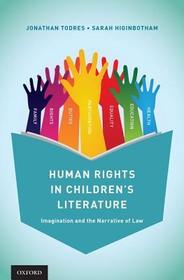
Human Rights in Children's Literature
Imagination and the Narrative of Law
- Publisher's listprice GBP 105.00
-
47 407 Ft (45 150 Ft + 5% VAT)
The price is estimated because at the time of ordering we do not know what conversion rates will apply to HUF / product currency when the book arrives. In case HUF is weaker, the price increases slightly, in case HUF is stronger, the price goes lower slightly.
- Discount 10% (cc. 4 740 Ft off)
- Discounted price 42 667 Ft (40 635 Ft + 5% VAT)
Subcribe now and take benefit of a favourable price.
Subscribe
47 407 Ft

Availability
printed on demand
Why don't you give exact delivery time?
Delivery time is estimated on our previous experiences. We give estimations only, because we order from outside Hungary, and the delivery time mainly depends on how quickly the publisher supplies the book. Faster or slower deliveries both happen, but we do our best to supply as quickly as possible.
Product details:
- Publisher OUP USA
- Date of Publication 28 January 2016
- ISBN 9780190213343
- Binding Hardback
- No. of pages320 pages
- Size 236x157x22 mm
- Weight 590 g
- Language English 0
Categories
Short description:
How can children grow to realize their inherent human rights and respect the rights of others? This book explores this question through children's literature from Peter Rabbit to Horton Hears a Who! to Harry Potter. The authors investigate children's rights under international law - identity and family rights, the right to be heard, the right to be free from discrimination, and other civil, political, economic, social and cultural rights - and consider the way in which those rights are embedded in children's literature.
MoreLong description:
How can children grow to realize their inherent rights and respect the rights of others? In this book, authors Jonathan Todres and Sarah Higinbotham explore this question through both human rights law and children's literature. Both international and domestic law affirm that children have rights, but how are these norms disseminated so that they make a difference in children's lives? Human rights education research demonstrates that when children learn about human rights, they exhibit greater self-esteem and respect the rights of others. The Convention on the Rights of the Child--the most widely-ratified human rights treaty--not only ensures that children have rights, it also requires that states make those rights "widely known, by appropriate and active means, to adults and children alike." This first-of-its-kind requirement for a human rights treaty indicates that if rights are to be meaningful to the lives of children, then government and civil society must engage with those rights in ways that are relevant to children.
Human Rights in Children's Literature investigates children's rights under international law - identity and family rights, the right to be heard, the right to be free from discrimination, and other civil, political, economic, social and cultural rights - and considers the way in which those rights are embedded in children's literature from Peter Rabbit to Horton Hears a Who! to Harry Potter. This book traverses children's rights law, literary theory, and human rights education to argue that in order for children to fully realize their human rights, they first have to imagine and understand them.
One of its strengths is that it does not merely depend on adults' analyses of key works of children's literature, but it also incorporates responses from child readers themselves. As the authors explain, they 'designed a qualitative, descriptive study' that involved their facilitation of reading groups comprised of 'children as young as four years old and as old as seventeen in their natural settings (schools and after-school programs)'; in turn, they drew on the participants' insights, anecdotes and questions as they considered how 'children's books allow children to think about human rights in ways that are developmentally suitable and profoundly imaginative'. s
Table of Contents:
Foreword by Carol Bellamy, Former Executive Director of UNICEF
Preface by Jonathan Todres
Acknowledgments
Chapter 1: Making Children's Rights Widely Known
Chapter 2: Participation Rights and the Voice of the Child
Chapter 3: Confronting Discrimination, Pursuing Equality
Chapter 4: Identity Rights and Family Rights
Chapter 5: Civil and Political Rights of Children: Accountability with Dignity
Chapter 6: Securing Child Well-being: The Economic, Social, and Cultural Rights of the Child
Chapter 7: Adults in the World of Children's Literature
Chapter 8: Reading, Rights, and the Best Interests of the Child
Appendix 1: United Nations Convention on the Rights of the Child
Appendix 2: Discrimination against Children
Appendix 3: Cinderella around the World
Appendix 4: Empirical Study: How Children Interpret Human Rights in Stories
Children's Literature Bibliography
Bibliography
For more information
Index

