

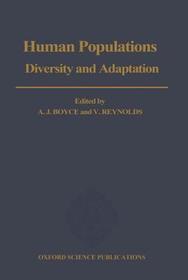
Human Populations
Diversity and Adaptation
- Publisher's listprice GBP 117.50
-
53 051 Ft (50 525 Ft + 5% VAT)
The price is estimated because at the time of ordering we do not know what conversion rates will apply to HUF / product currency when the book arrives. In case HUF is weaker, the price increases slightly, in case HUF is stronger, the price goes lower slightly.
- Discount 10% (cc. 5 305 Ft off)
- Discounted price 47 746 Ft (45 473 Ft + 5% VAT)
Subcribe now and take benefit of a favourable price.
Subscribe
53 051 Ft

Availability
Out of print
Why don't you give exact delivery time?
Delivery time is estimated on our previous experiences. We give estimations only, because we order from outside Hungary, and the delivery time mainly depends on how quickly the publisher supplies the book. Faster or slower deliveries both happen, but we do our best to supply as quickly as possible.
Product details:
- Publisher OUP Oxford
- Date of Publication 10 August 1995
- ISBN 9780198522942
- Binding Hardback
- No. of pages296 pages
- Size 241x162x21 mm
- Weight 600 g
- Language English
- Illustrations line figures, maps, tables 0
Categories
Short description:
Human populations can be defined as collectivities of people living together and sharing a number of biological and social characteristics. Such populations differ from one another in many respects. There are genetic differences, which may be the result of natural selection or random genetic drift. There are morphological differences which may be the results of genetic factors but are also influenced by nutrition, and other environmental features. There are cultural
differences which to a greater or lesser extent control human behaviour. A further kind of diversity in human populations is their disease association. Because of the different climatic zones of the work, different disease vectors and agents alter the disease environment of human beings. All cultures
attempt to control disease, but in much of the world these attempts are far from successful, leading to differential patterns of morbidity and mortality in different populations. All of the processes distinguished above interact with each other to produce the diversity of populations we encounter across the world. The study of population genetic has led to the discovery of the selective advantages of particular genes, together with an understanding that not all genetic differences are the
product of natural selection, but that neutral processes operate as well.
Human history is to some extent the history of population migrations, and as a result the world's populations are not discrete entities but grade into each other at the genetic, morphological and cultural levels. The present volume explores all these aspects of human diversity and the various ways in which they constitute adaptations to the diverse environments in which human populations live.
Long description:
As so much of human history is the history of population migrations, all the world's populations interact at the genetic, morphological and cultural levels.
In the nineteenth century, populations were placed on a scale from 'primitive' to 'advanced'. With the impact of Darwinism, processes of natural selection were sought that might be capable of explaining physical inter-population differences. Continued study of population genetics has led to the discovery of the selective advantages of particular genes, together with an understanding that not all genetic differences are the product of natural selection, but that neutral processes operate as
well.
This is an exploration of aspects of human diversity and the ways in which human populations adapt to their environments.

