

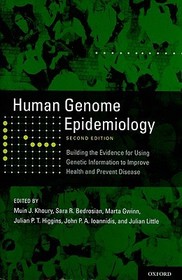
Human Genome Epidemiology,
Building the evidence for using genetic information to improve health and prevent disease
- Publisher's listprice GBP 96.00
-
43 344 Ft (41 280 Ft + 5% VAT)
The price is estimated because at the time of ordering we do not know what conversion rates will apply to HUF / product currency when the book arrives. In case HUF is weaker, the price increases slightly, in case HUF is stronger, the price goes lower slightly.
- Discount 10% (cc. 4 334 Ft off)
- Discounted price 39 010 Ft (37 152 Ft + 5% VAT)
Subcribe now and take benefit of a favourable price.
Subscribe
43 344 Ft

Availability
printed on demand
Why don't you give exact delivery time?
Delivery time is estimated on our previous experiences. We give estimations only, because we order from outside Hungary, and the delivery time mainly depends on how quickly the publisher supplies the book. Faster or slower deliveries both happen, but we do our best to supply as quickly as possible.
Product details:
- Edition number 2
- Publisher OUP USA
- Date of Publication 4 February 2010
- ISBN 9780195398441
- Binding Hardback
- No. of pages704 pages
- Size 165x234x45 mm
- Weight 1103 g
- Language English 0
Categories
Long description:
The first edition of Human Genome Epidemiology, published in 2004, discussed how the epidemiologic approach provides an important scientific foundation for studying the continuum from gene discovery to the development, applications and evaluation of human genome information in improving health and preventing disease. Since that time, advances in human genomics have continued to occur at a breathtaking pace.
With contributions from leaders in the field from around the world, this new edition is a fully updated look at the ways in which genetic factors in common diseases are studied. Methodologic developments in collection, analysis and synthesis of data, as well as issues surrounding specific applications of human genomic information for medicine and public health are all discussed. In addition, the book focuses on practical applications of human genome variation in clinical practice and disease prevention. Students, clinicians, public health professionals and policy makers will find the book a useful tool for understanding the rapidly evolving methods of the discovery and use of genetic information in medicine and public health in the 21st century.

