

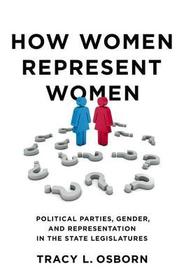
How Women Represent Women
Political Parties, Gender and Representation in the State Legislatures
- Publisher's listprice GBP 107.50
-
51 358 Ft (48 912 Ft + 5% VAT)
The price is estimated because at the time of ordering we do not know what conversion rates will apply to HUF / product currency when the book arrives. In case HUF is weaker, the price increases slightly, in case HUF is stronger, the price goes lower slightly.
- Discount 10% (cc. 5 136 Ft off)
- Discounted price 46 222 Ft (44 021 Ft + 5% VAT)
Subcribe now and take benefit of a favourable price.
Subscribe
51 358 Ft

Availability
printed on demand
Why don't you give exact delivery time?
Delivery time is estimated on our previous experiences. We give estimations only, because we order from outside Hungary, and the delivery time mainly depends on how quickly the publisher supplies the book. Faster or slower deliveries both happen, but we do our best to supply as quickly as possible.
Product details:
- Publisher OUP USA
- Date of Publication 22 March 2012
- ISBN 9780199845347
- Binding Hardback
- No. of pages256 pages
- Size 236x152x25 mm
- Weight 517 g
- Language English 0
Categories
Short description:
How Women Represent Women argues that political parties fundamentally structure the ways in which women legislators represent women's interests. Using original election, sponsorship and roll call data across the U.S. state chambers from 1999-2000, Osborn shows how parties shape the policy alternatives women offer.
MoreLong description:
Though the number of women elected to the U.S. state legislatures has grown substantially in the last forty years, researchers still struggle to connect women's presence in the legislature to public policy outcomes that affect women. One reason for this struggle is that we lack a complete understanding of how political parties modify the relationship between women legislators' interests in representing women and the creation of public policies affecting women.
In How Women Represent Women: Political Parties, Gender and Representation in the State Legislatures, Tracy L. Osborn examines the two avenues through which political parties fundamentally affect the ways in which partisan women legislators pursue women's issues policies. She argues that political parties structure representation in two ways. First, women's party identities shape the types of policy alternatives they offer to solve women's policy problems. Second, parties organize the legislative process by holding majority control, to varying degrees, over agenda setting and policy creation, promoting some women legislators' policy proposals over others.
Osborn tests these two avenues of influence by comparing partisan women's legislative behavior toward the creation of women's issues policies across different party environments in the U.S. state legislatures. She uses original election, sponsorship, and roll call data in nearly all ninety-nine state legislative chambers in 1999-2000. She concludes that Republican and Democratic women offer different solutions to women's policy problems based on their party identities. Depending on which party controls the legislative process and how strongly they do so, this party control promotes one set of partisan policy alternatives over the other. Thus, political parties determine which women's issues policies become law. Ultimately, this book demonstrates how essential parties are to understanding how women elected to public office translate their interest in women's issues into substantive public policy.
Osborn's book is well written, important and original...a valuable contribution to understanding how and under what circumstances the representation of womens interest occurs.
Table of Contents:
List of Tables
List of Figures
Chapter 1: Introduction
Chapter 2: How Parties Affect Gender and Representation
Chapter 3: Examining Party Identity and Institutional Partisanship
Chapter 4: Party Identity and Issue Preferences in the 1998 Election
Chapter 5: Party Identity and Institutional Partisanship in Agenda Setting
Chapter 6: Institutional Partisanship and Roll Call Voting
Chapter 7: Conclusion
Appendix A: NPAT Questionnaire and Additional Analyses from Chapter 4
Appendix B: Coding Scheme for Bills and Roll Call Votes and Additional
Analyses for Chapters 5-6
References
Index

