

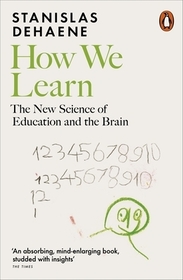
How We Learn
The New Science of Education and the Brain
-
GET 20% OFF
- Publisher's listprice GBP 10.99
-
4 961 Ft (4 725 Ft + 5% VAT)
The price is estimated because at the time of ordering we do not know what conversion rates will apply to HUF / product currency when the book arrives. In case HUF is weaker, the price increases slightly, in case HUF is stronger, the price goes lower slightly.
- Discount 20% (cc. 992 Ft off)
- Discounted price 3 969 Ft (3 780 Ft + 5% VAT)
3 969 Ft

Availability
Estimated delivery time: In stock at the publisher, but not at Prospero's office. Delivery time approx. 3-5 weeks.
Not in stock at Prospero.
Why don't you give exact delivery time?
Delivery time is estimated on our previous experiences. We give estimations only, because we order from outside Hungary, and the delivery time mainly depends on how quickly the publisher supplies the book. Faster or slower deliveries both happen, but we do our best to supply as quickly as possible.
Product details:
- Publisher Penguin Books Ltd
- Date of Publication 28 January 2021
- Number of Volumes B-format paperback
- ISBN 9780141989303
- Binding Paperback
- No. of pages352 pages
- Size 198x129x20 mm
- Weight 282 g
- Language English 116
Categories
Long description:
'Absorbing, mind-enlarging, studded with insights ... This could have significant real-world results' Sunday Times
Humanity's greatest feat is our incredible ability to learn. Even in their first year, infants acquire language, visual and social knowledge at a rate that surpasses the best supercomputers. But how, exactly, do our brains learn?
In How We Learn, leading neuroscientist Stanislas Dehaene delves into the psychological, neuronal, synaptic and molecular mechanisms of learning. Drawing on case studies of children who learned despite huge difficulty and trauma, he explains why youth is such a sensitive period, during which brain plasticity is maximal, but also assures us that our abilities continue into adulthood. We can all enhance our learning and memory at any age and 'learn to learn' by taking maximal advantage of the four pillars of the brain's learning algorithm: attention, active engagement, error feedback and consolidation.
The human brain is an extraordinary machine. Its ability to process information and adapt to circumstances by reprogramming itself is unparalleled, and it remains the best source of inspiration for recent developments in artificial intelligence. How We Learn finds the boundary of computer science, neurobiology, cognitive psychology and education to explain how learning really works and how to make the best use of the brain's learning algorithms - and even improve them - in our schools and universities as well as in everyday life.

