

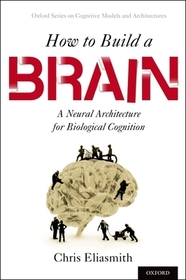
How to Build a Brain
A Neural Architecture for Biological Cognition
Series: Oxford Series on Cognitive Models and Architectures;
- Publisher's listprice GBP 157.50
-
75 245 Ft (71 662 Ft + 5% VAT)
The price is estimated because at the time of ordering we do not know what conversion rates will apply to HUF / product currency when the book arrives. In case HUF is weaker, the price increases slightly, in case HUF is stronger, the price goes lower slightly.
- Discount 10% (cc. 7 525 Ft off)
- Discounted price 67 721 Ft (64 496 Ft + 5% VAT)
Subcribe now and take benefit of a favourable price.
Subscribe
75 245 Ft

Availability
printed on demand
Why don't you give exact delivery time?
Delivery time is estimated on our previous experiences. We give estimations only, because we order from outside Hungary, and the delivery time mainly depends on how quickly the publisher supplies the book. Faster or slower deliveries both happen, but we do our best to supply as quickly as possible.
Product details:
- Edition number 1
- Publisher OUP USA
- Date of Publication 27 June 2013
- ISBN 9780199794546
- Binding Hardback
- No. of pages480 pages
- Size 183x257x38 mm
- Weight 1165 g
- Language English 0
Categories
Short description:
Chris Eliasmith presents a new approach to understanding the neural implementation of cognition in a way that is centrally driven by biological considerations. According to the Semantic Pointer Hypothesis, higher-level cognitive functions in biological systems are made possible by semantic pointers.
MoreLong description:
In this book, Chris Eliasmith presents a new approach to understanding the neural implementation of cognition in a way that is centrally driven by biological considerations. He calls the general architecture that results from the application of this approach the Semantic Pointer Architecture (SPA), based on the Semantic Pointer Hypothesis. According to this hypothesis, higher-level cognitive functions in biological systems are made possible by semantic pointers. These pointers are neural representations that carry partial semantic content and can be built up into the complex representational structures necessary to support cognition. The SPA architecture demonstrates how neural systems generate, compose, and control the flow of semantics pointers. Eliasmith describes in detail the theory and empirical evidence supporting the SPA, and presents several examples of its application to cognitive modeling, covering the generation of semantic pointers from visual data, the application of semantic pointers for motor control, and most important, the use of semantic pointers for representation of language-like structures, cognitive control, syntactic generalization, learning of new cognitive strategies, and language-based reasoning. He agues that the SPA provides an alternative to the dominant paradigms in cognitive science, including symbolicism, connectionism, and dynamicism.
MoreTable of Contents:
Contents
1 The science of cognition
1.1 The last 50 years
1.2 How we got here
1.3 Where we are
1.4 Questions and answers
1.5 Nengo: An introduction
Part I: How to build a brain
2 An introduction to brain building
2.1 Brain parts
2.2 A framework for building a brain
2.2.1 Representation
2.2.2 Transformation
2.2.3 Dynamics
2.2.4 The three principles
2.3 Levels
2.4 Nengo: Neural representation
3 Biological cognition - Semantics
3.1 The semantic pointer hypothesis
3.2 What is a semantic pointer?
3.3 Semantics: An overview
3.4 Shallow semantics
3.5 Deep semantics for perception
3.6 Deep semantics for action
3.7 The semantics of perception and action
3.8 Nengo: Neural computations
4 Biological cognition - Syntax
4.1 Structured representations
4.2 Binding without neurons
4.3 Binding with neurons.
4.4 Manipulating structured representations
4.5 Learning structural manipulations
4.6 Clean-up memory and scaling
4.7 Example: Fluid intelligence
4.8 Deep semantics for cognition
4.9 Nengo: Structured representations in neurons
5 Biological cognition - Control
5.1 The flow of information
5.2 The basal ganglia
5.3 Basal ganglia, cortex, and thalamus
5.4 Example: Fixed sequences of actions
5.5 Attention and the routing of information
5.6 Example: Flexible sequences of actions
5.7 Timing and control
5.8 Example: The Tower of Hanoi
5.9 Nengo: Question answering
6 Biological cognition - Memory and learning
6.1 Extending cognition through time
6.2 Working memory
6.3 Example: Serial list memory
6.4 Biological learning
6.5 Example: Learning new actions
6.6 Example: Learning new syntactic manipulations
6.7 Nengo: Learning
7 The Semantic Pointer Architecture (SPA)
7.1 A summary of the SPA
7.2 A SPA unified network
7.3 Tasks
7.3.1 Recognition
7.3.2 Copy drawing
7.3.3 Reinforcement learning
7.3.4 Serial working memory
7.3.5 Counting
7.3.6 Question answering
7.3.7 Rapid variable creation
7.3.8 Fluid reasoning
7.3.9 Discussion
7.4 A unified view: Symbols and probabilities
7.5 Nengo: Advanced modeling methods
Part II Is that how you build a brain?
8 Evaluating cognitive theories 341
8.1 Introduction
8.2 Core cognitive criteria (CCC)
8.2.1 Representational structure
8.2.1.1 Systematicity
8.2.1.2 Compositionality
8.2.1.3 Productivity
8.2.1.4 The massive binding problem
8.2.2 Performance concerns
8.2.2.1 Syntactic generalization
8.2.2.2 Robustness
8.2.2.3 Adaptability
8.2.2.4 Memory
8.2.2.5 Scalability
8.2.3 Scientific merit
8.2.3.1 Triangulation (contact with more sources of data)
8.2.3.2 Compactness
8.3 Conclusion
8.4 Nengo Bonus: How to build a brain - a practical guide
9 Theories of cognition
9.1 The state of the art
9.1.1 ACT-R
9.1.2 Synchrony-based approaches
9.1.3 Neural blackboard architecture (NBA)
9.1.4 The integrated connectionist/symbolic architecture (ICS)
9.1.5 Leabra
9.1.6 Dynamic field theory (DFT)
9.2 An evaluation
9.2.1 Representational structure
9.2.2 Performance concerns
9.2.3 Scientific merit
9.2.4 Summary
9.3 The same...
9.4 ...but different
9.5 The SPA versus the SOA
10 Consequences and challenges
10.1 Representation
10.2 Concepts
10.3 Inference
10.4 Dynamics
10.5 Challenges
10.6 Conclusion
A Mathematical notation and overview
A.1 Vectors
A.2 Vector spaces
A.3 The dot product
A.4 Basis of a vector space
A.5 Linear transformations on vectors
A.6 Time derivatives for dynamics
B Mathematical derivations for the NEF
B.1 Representation
B.1.1 Encoding
B.1.2 Decoding
B.2 Transformation
B.3 Dynamics
C Further details on deep semantic models
C.1 The perceptual model
C.2 The motor model
D Mathematical derivations for the SPA
D.1 Binding and unbinding HRRs
D.2 Learning high-level transformations
D.3 Ordinal serial encoding model
D.4 Spike-timing dependent plasticity
D.5 Number of neurons for representing structure
E SPA model details
E.1 Tower of Hanoi
Bibliography
Index

