

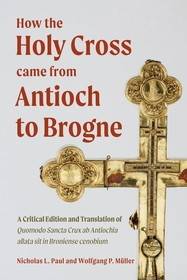
How the Holy Cross came from Antioch to Brogne – A Critical Edition and Translation of Quomodo Sancta Crux ab Antiochia allata sit in Broniense c
A Critical Edition and Translation of Quomodo Sancta Crux ab Antiochia allata sit in Broniense cenobium
Series: Crusading in Context; 8;
- Publisher's listprice GBP 85.00
-
38 377 Ft (36 550 Ft + 5% VAT)
The price is estimated because at the time of ordering we do not know what conversion rates will apply to HUF / product currency when the book arrives. In case HUF is weaker, the price increases slightly, in case HUF is stronger, the price goes lower slightly.
- Discount 10% (cc. 3 838 Ft off)
- Discounted price 34 540 Ft (32 895 Ft + 5% VAT)
Subcribe now and take benefit of a favourable price.
Subscribe
38 377 Ft

Availability
Estimated delivery time: In stock at the publisher, but not at Prospero's office. Delivery time approx. 3-5 weeks.
Not in stock at Prospero.
Why don't you give exact delivery time?
Delivery time is estimated on our previous experiences. We give estimations only, because we order from outside Hungary, and the delivery time mainly depends on how quickly the publisher supplies the book. Faster or slower deliveries both happen, but we do our best to supply as quickly as possible.
Product details:
- Publisher Boydell and Brewer
- Date of Publication 25 November 2025
- Number of Volumes Print PDF
- ISBN 9781837653232
- Binding Hardback
- No. of pages256 pages
- Size 234x156x17 mm
- Weight 468 g
- Language English
- Illustrations 4 maps and 7 b/w illus. 767
Categories
Short description:
The first critical edition, with facing-page English translation, of a thirteenth-century source, offering insights into crusading, material culture, and aristocratic-monastic relations.
MoreLong description:
The first critical edition, with facing-page English translation, of a thirteenth-century source, offering insights into crusading, material culture, and aristocratic-monastic relations. In 1152, a knight from the southern Low Countries named Manasses of Hierges returned home after eleven years spent crusading in the Holy Land. He carried with him a precious relic, said to be a fragment of the True Cross that had belonged to the princes of Antioch. Nearly sixty years later, a writer associated with a nearby monastery composed a new Latin narrative, hagiographical, and liturgical textual programme known as Quomodo Sancta Crux ab Antiochia allata sit in Broniense cenobium (How the Holy Cross Came from Antioch to the Monastery of Brogne). It tells the story of Manasses, his career in Europe and the Near East, and of the conflict that broke out over possession of the relic after his death. This volume provides the first critical edition and English translation of a source that contributes greatly to our knowledge of the medieval world, from crusading to material religion to relations between the lay aristocracy and religious communities. The work of a learned author with ambitions to a high literary and homiletic style, it offers a fresh perspective on the question of what motivated crusaders and on the history of the Holy Land under crusader occupation, providing critical new details to the story of the civil war between Queen Melisende of Jerusalem and her son, King Baldwin III. The sustained account of the conflict over a relic provides a window into the importance of sacred objects, and competing notions of sacrality, legal possession, and value. Previously unknown to historians, this work provides a rich illustration of the place of crusading in the memory of a local community. A detailed critical apparatus establishes what can be known about the work's composition and the author's reliance on Classical, Patristic, and Scriptural authorities, while an introduction gives an account of the work's political, cultural, and intellectual context.
More
