

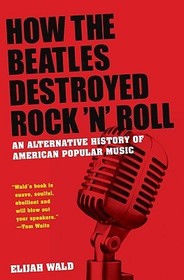
How the Beatles Destroyed Rock n Roll
An Alternative History of American Popular Music
- Publisher's listprice GBP 16.99
-
7 670 Ft (7 305 Ft + 5% VAT)
The price is estimated because at the time of ordering we do not know what conversion rates will apply to HUF / product currency when the book arrives. In case HUF is weaker, the price increases slightly, in case HUF is stronger, the price goes lower slightly.
- Discount 10% (cc. 767 Ft off)
- Discounted price 6 903 Ft (6 575 Ft + 5% VAT)
Subcribe now and take benefit of a favourable price.
Subscribe
7 670 Ft

Availability
Uncertain availability. Please turn to our customer service.
Why don't you give exact delivery time?
Delivery time is estimated on our previous experiences. We give estimations only, because we order from outside Hungary, and the delivery time mainly depends on how quickly the publisher supplies the book. Faster or slower deliveries both happen, but we do our best to supply as quickly as possible.
Product details:
- Publisher OUP USA
- Date of Publication 27 August 2009
- ISBN 9780195341546
- Binding Hardback
- No. of pages336 pages
- Size 240x162x26 mm
- Weight 646 g
- Language English
- Illustrations 35 black and white half tone illustrations 0
Categories
Short description:
How the Beatles Destroyed Rock 'n' Roll is an alternative history of American music that, instead of recycling the familiar clichés of jazz and rock, looks at what people were playing, hearing and dancing to throughout the course of the 20th century, using a wealth of original research, curious quotations, and an irreverent fascination with the oft-despised commercial mainstream.
MoreLong description:
"There are no definitive histories," writes Elijah Wald, in this provocative reassessment of American popular music, "because the past keeps looking different as the present changes." Earlier musical styles sound different to us today because we hear them through the musical filter of other styles that came after them, all the way through funk and hiphop.
As its blasphemous title suggests, How the Beatles Destroyed Rock 'n' Roll rejects the conventional pieties of mainstream jazz and rock history. Rather than concentrating on those traditionally favored styles, the book traces the evolution of popular music through developing tastes, trends and technologies?including the role of records, radio, jukeboxes and television ?to give a fuller, more balanced account of the broad variety of music that captivated listeners over the
course of the twentieth century. Wald revisits original sources?recordings, period articles, memoirs, and interviews?to highlight how music was actually heard and experienced over the years. And in a refreshing departure from more typical histories, he focuses on the world of working musicians and ordinary
listeners rather than stars and specialists. He looks for example at the evolution of jazz as dance music, and rock 'n' roll through the eyes of the screaming, twisting teenage girls who made up the bulk of its early audience. Duke Ellington, Benny Goodman, Frank Sinatra, Elvis Presley, Chuck Berry, and the Beatles are all here, but Wald also discusses less familiar names like Paul Whiteman, Guy Lombardo, Mitch Miller, Jo Stafford, Frankie Avalon, and the Shirelles, who in some cases were far
more popular than those bright stars we all know today, and who more accurately represent the mainstream of their times.
Written with verve and style, How the Beatles Destroyed Rock 'n' Roll shakes up our staid notions of music history and helps us hear American popular music with new ears.
Wald's argument is built through 16 chapters of well-researched and brilliantly argued historical contextualising.

