

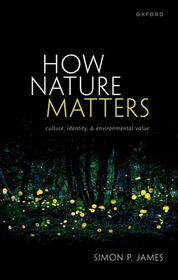
How Nature Matters
Culture, Identity, and Environmental Value
- Publisher's listprice GBP 59.00
-
26 638 Ft (25 370 Ft + 5% VAT)
The price is estimated because at the time of ordering we do not know what conversion rates will apply to HUF / product currency when the book arrives. In case HUF is weaker, the price increases slightly, in case HUF is stronger, the price goes lower slightly.
- Discount 20% (cc. 5 328 Ft off)
- Discounted price 21 311 Ft (20 296 Ft + 5% VAT)
- Discount is valid until: 30 June 2026
Subcribe now and take benefit of a favourable price.
Subscribe
26 638 Ft

Availability
Estimated delivery time: In stock at the publisher, but not at Prospero's office. Delivery time approx. 3-5 weeks.
Not in stock at Prospero.
Why don't you give exact delivery time?
Delivery time is estimated on our previous experiences. We give estimations only, because we order from outside Hungary, and the delivery time mainly depends on how quickly the publisher supplies the book. Faster or slower deliveries both happen, but we do our best to supply as quickly as possible.
Product details:
- Publisher OUP Oxford
- Date of Publication 25 August 2022
- ISBN 9780198871613
- Binding Hardback
- No. of pages184 pages
- Size 223x144x14 mm
- Weight 346 g
- Language English 232
Categories
Short description:
James presents an original theory of nature's value based on part-whole relations, and solves the difficult problem of how we should conceptualize nature's cultural values. This accessible, engagingly written book will be essential reading for all those who wish to understand the moral and metaphysical dimensions of environmental issues.
MoreLong description:
HOW NATURE MATTERS presents an original theory of nature's value based on part—whole relations. James argues that when natural things have cultural value, they do not always have it as means to valuable ends. In many cases, they have value as parts of valuable wholes — as parts of traditions, for instance, or cultural identities.
James develops his theory by investigating twelve real-world cases, ranging from the veneration of sacred trees to the hunting of dugongs. He also analyses some key policy-related debates and explores various fundamental issues in environmental philosophy, including the question of whether anything on earth qualifies as natural.
This accessible, engagingly written book will be essential reading for all those who wish to understand the moral and metaphysical dimensions of environmental issues.
This admirably well-written book makes a convincing case for moving beyond the instrumental vs intrinsic value contrast when assessing nature's contributions to human meaning
Table of Contents:
Acknowledgements
Introduction
PART 1: Means and Ends
Instrumentality and Causation
Cultural Ecosystem Services
Limitations of the Standard Model
PART 2: Parts and Wholes
The Meanings of Things
Constitution
Value and Disvalue
Deep Ecology, Essentialism, Narrative, and Relational Value
PART 3: Wider issues
Why Nature?
Beyond Value for Us
Constitution and Rights
Conclusion
Bibliography

