

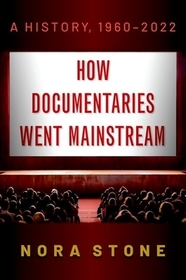
How Documentaries Went Mainstream
A History, 1960-2022
- Publisher's listprice GBP 86.00
-
38 829 Ft (36 980 Ft + 5% VAT)
The price is estimated because at the time of ordering we do not know what conversion rates will apply to HUF / product currency when the book arrives. In case HUF is weaker, the price increases slightly, in case HUF is stronger, the price goes lower slightly.
- Discount 10% (cc. 3 883 Ft off)
- Discounted price 34 946 Ft (33 282 Ft + 5% VAT)
Subcribe now and take benefit of a favourable price.
Subscribe
38 829 Ft

Availability
printed on demand
Why don't you give exact delivery time?
Delivery time is estimated on our previous experiences. We give estimations only, because we order from outside Hungary, and the delivery time mainly depends on how quickly the publisher supplies the book. Faster or slower deliveries both happen, but we do our best to supply as quickly as possible.
Product details:
- Publisher OUP USA
- Date of Publication 13 June 2023
- ISBN 9780197557297
- Binding Hardback
- No. of pages234 pages
- Size 235x156x18 mm
- Weight 467 g
- Language English 412
Categories
Short description:
Drawing on archival documents, industry trade journals and popular press, and interviews with filmmakers and film distributors, this book illuminates how documentary features have become more plentiful, popular, and profitable than ever before.
MoreLong description:
Since the 1960s, documentary films have moved closer to the mainstream, thanks to the popularity of rockumentaries, association with the independent film movement, support from public and cable television, and the rise of streaming video services. Documentary films have become reliable earners at the U.S. box office and ubiquitous on streaming platforms, while historically they existed on the margins of mainstream media. How do we explain the growing commercialization of documentary films and the conditions that fueled their transformation?
The growing commercialization of documentary film has not gone unnoticed, but it has not been sufficiently explained. Streaming and the growing interest in reality TV are usually offered as initial explanations whenever a documentary enters the cultural conversation or breaks a box-office record, but neither of those causes grapple with the overlapping causal mechanisms that commercialized documentary film. How Documentaries Went Mainstream provides a more comprehensive and meaningful periodization of the commercialization of documentary film. Although the commercial ascension of documentary films might seem meteoric, it is the culmination of decades-long efforts that have developed and fortified the audience for documentary features. Author Nora Stone refines rough explanations of these efforts through a robust synoptic history of the market for documentary films, using knowledge of film economics and the norms of industry discourse to tell a richer story. This periodization will allow scholars to compare the commercialization of documentary film with other genres. Drawing on archival documents, industry trade journals and popular press, and interviews with filmmakers and film distributors, Stone illuminates how documentary features have become more plentiful, popular, and profitable than ever before.
Stone's history of post-vérité U.S. documentary is, simply put, the book I've been waiting for. For too long, documentary histories have focused primarily on makers and movements, but Stone weaves an account of the film markets, documentary institutions, and shifts in film culture driving documentary's increased public visibility. Whether discussing canonical works, box office flops, public television broadcasts, or popular documentary hits, this book provides a narrative that reframes and illuminates the major changes in the documentary landscape over the last half century.
Table of Contents:
Introduction: How Documentaries Went Mainstream
Chapter 1: 1960 to 1977, Direct Cinema Blossoms, But Little Support for Documentary Films in Theaters
Chapter 2: 1978 to 1989, A Rising Tide: How the Independent Film Movement Boosted Documentaries
Chapter 3: 1978 to 1990, Fighting For A Place On Public Television: Independent Filmmakers Lobby
Chapter 4: 1990 to 1999, Television or Cinema? Redefining Documentary for Prestige and Profit
Chapter 5: 2000 to 2007, The Docbuster Era
Chapter 6: 2008 to 2022, Streaming Video Drives Documentary Production Trends and Private Investment
Conclusion: Documentary Film Inches Closer to the Center, But Core Tensions Remain
Bibliography
Index

