

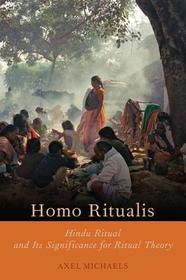
Homo Ritualis
Hindu Ritual and Its Significance to Ritual Theory
Series: Oxford Ritual Studies Series;
- Publisher's listprice GBP 150.00
-
67 725 Ft (64 500 Ft + 5% VAT)
The price is estimated because at the time of ordering we do not know what conversion rates will apply to HUF / product currency when the book arrives. In case HUF is weaker, the price increases slightly, in case HUF is stronger, the price goes lower slightly.
- Discount 10% (cc. 6 773 Ft off)
- Discounted price 60 953 Ft (58 050 Ft + 5% VAT)
Subcribe now and take benefit of a favourable price.
Subscribe
67 725 Ft

Availability
printed on demand
Why don't you give exact delivery time?
Delivery time is estimated on our previous experiences. We give estimations only, because we order from outside Hungary, and the delivery time mainly depends on how quickly the publisher supplies the book. Faster or slower deliveries both happen, but we do our best to supply as quickly as possible.
Product details:
- Publisher OUP USA
- Date of Publication 7 January 2016
- ISBN 9780190262624
- Binding Hardback
- No. of pages400 pages
- Size 160x239x25 mm
- Weight 686 g
- Language English
- Illustrations 3 illustrations 0
Categories
Short description:
Homo Ritualis describes and analyzes various forms of Hindu rituals and examines conceptual components such as framing, formality modality and theories of meaning. The first book to present a Hindu theory of rituals, it asks how indigenous terms and notions of ritual contribute to ritual theory.
MoreLong description:
Are the richness and diversity of rituals and celebrations in South Asia unique? Can we speak of a homo ritualis when it comes to India or Hinduism? Are Indians or Hindus more involved in rituals than other people? If so, what makes them special? Homo Ritualis is the first book to present a Hindu theory of rituals. Based on extensive textual studies and field-work in Nepal and India, Axel Michaels argues that ritual is a distinctive way of acting, which, as in the theater, can be distinguished from other forms of action. The book analyzes ritual in these cultural-specific and religious contexts, taking into account how indigenous terms and theories affect and contribute to current ritual theory. It describes and investigates various forms of Hindu rituals and festivals, such as life-cycle rituals, the Vedic sacrifice, vows processions, and the worship of deities (puja). It also examines conceptual components of (Hindu) rituals such as framing, formality, modality, and theories of meaning.
MoreTable of Contents:
Preface
Acknowledgements
Abbreviations
Plates and Figures
Pronunciation of Indian Words
Introduction
Part I: Framing
1. The Beginning of Rituals
1.1 The Solemn Intention (samkalpa)
1.2 Greeting and Ritualized Greeting (namaskara)
Conclusion
Part II: Formality
2. Repetitive Rules (vidhi)
2.1 The Grammar of Rituals
2.2 A Preliminary "Grammar" of Newar Life-cycle Rituals
2.3 Rituals in Handbooks (paddhati)
3. Agency in Ritual
3.1 Ritual Competency (adhikara)
3.2 Atonements for Ritual Mishaps (prayascitta)
3.3 The Comic Side of Ritual Formality
4. Performed and Played Rituals (lila)
4.1 Music and Ritual Music
4.2 Dance and Ritual Dance
4.3 Emotions and Ritual Emotions
Conclusion
Part III: Modality
5. Individualized and Domestic Rituals (samskara)
5.1 The Boy's Initiation
5.2 The Girl's Initiation
5.3 The Marriage
5.4 Death Rituals and Redemption
6. Collective and Public Rituals
6.1 Temple Festivals (utsava)
6.2 Vows (vrata)
6.3 Pilgrimages and Processions (yatra)
7. Transcendence in Rituals
7.1 The Vedic Sacrifice (yajña)
7.2 The Fire Sacrifice (homa)
7.3 Worship and Prayer (puja)
7.4 E-darshan and Cyber-puja
Conclusion
Part IV: Meaning
8. Meaning and Function
8.1 The Cultural Studies Approach
8.2 The Cognitive Sciences approach
9. The Purvamimamsa Theory of Ritual Efficacy
Conclusion
Part V: The Hindu Path of Ritual-Summary
Appendix: Automatic Detection of Ritual Structures
Glossary
References

