

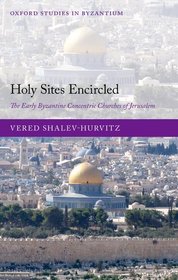
Holy Sites Encircled
The Early Byzantine Concentric Churches of Jerusalem
Series: Oxford Studies in Byzantium;
- Publisher's listprice GBP 122.50
-
55 308 Ft (52 675 Ft + 5% VAT)
The price is estimated because at the time of ordering we do not know what conversion rates will apply to HUF / product currency when the book arrives. In case HUF is weaker, the price increases slightly, in case HUF is stronger, the price goes lower slightly.
- Discount 10% (cc. 5 531 Ft off)
- Discounted price 49 778 Ft (47 408 Ft + 5% VAT)
Subcribe now and take benefit of a favourable price.
Subscribe
55 308 Ft

Availability
printed on demand
Why don't you give exact delivery time?
Delivery time is estimated on our previous experiences. We give estimations only, because we order from outside Hungary, and the delivery time mainly depends on how quickly the publisher supplies the book. Faster or slower deliveries both happen, but we do our best to supply as quickly as possible.
Product details:
- Publisher OUP Oxford
- Date of Publication 9 April 2015
- ISBN 9780199653775
- Binding Hardback
- No. of pages470 pages
- Size 240x162x33 mm
- Weight 856 g
- Language English
- Illustrations 138 illustrations 0
Categories
Short description:
This volume explores the architecture of Jerusalem's round and octagonal churches, the perceptions and architectural models that stood behind it, and their impact on both ideas and design in future architecture.
MoreLong description:
The round and octagonal churches of Jerusalem were the earliest of their kind. Powerful, monumental structures, recalling imperial mausolea and temples, they enshrined the holiest sites of Christianity. Constantine himself ordered the building of the first ones immediately after the council of Nicaea (325), his main objective being the authentication of Jesus's existence in Jerusalem in accordance with the council's resolutions, but the sites he chose in Palestine also obliterated reminiscences of Jewish or Pagan domination.
Holy Sites Encircled demonstrates that all four concentric churches of Jerusalem encircled new holy sites exclusively relating to the corporeal existence of Jesus or Mary, and that they were self-contained, and apse-less because the liturgy, including the Mass, was performed from the venerated centre. Offering intimate concentric spaces, as well as perpetual processions around these sites, they promoted the development of new feasts, shaping the city's liturgy and that of the whole Christian world. They were found especially suitable to compete with former religious landmarks and therefore many of their descendants outside Jerusalem were cathedrals.
This volume begins with the Church of the Holy Sepulchre, which replaced a pagan temple in Jerusalem city centre, and concludes with the Dome of the Rock, a unique Muslim structure, which was built by the Umayyads on the very site of the ruined Jewish Temple on Mount Moriah, using the concentric architecture of Jerusalem to establish their new authority. Illustrating how architectural form links together culture, politics, and society it explores the perceptions and architectural models that shaped these unusual churches and their impact, in both ideas and design, on future architecture.
Table of Contents:
List of Plates
List of Figures
List of Maps
List of Abbreviations
Part I: The Concentric Churches of Jerusalem
Introduction
The Development of the Ritual in the Churches of Jerusalem
The Churches of Jesus: The Fourth Century
The Churches of Mary: The Fifth Century
Holy Sites Encircled: New Forms of Architecture in Jerusalem Churches
Part II: The Scope of the Concentric Churches of Jerusalem
The Primacy of Jerusalem's Concentric Churches
The Palestinian Concentric Churches outside Jerusalem
The Impact: Palestine and Beyond
The Transformation of Function: The Dome of the Rock
Conclusion
Bibliography
Index

