

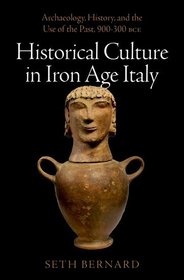
Historical Culture in Iron Age Italy
Archaeology, History, and the Use of the Past, 900-300 BCE
- Publisher's listprice GBP 57.00
-
25 735 Ft (24 510 Ft + 5% VAT)
The price is estimated because at the time of ordering we do not know what conversion rates will apply to HUF / product currency when the book arrives. In case HUF is weaker, the price increases slightly, in case HUF is stronger, the price goes lower slightly.
- Discount 10% (cc. 2 574 Ft off)
- Discounted price 23 162 Ft (22 059 Ft + 5% VAT)
Subcribe now and take benefit of a favourable price.
Subscribe
25 735 Ft

Availability
printed on demand
Why don't you give exact delivery time?
Delivery time is estimated on our previous experiences. We give estimations only, because we order from outside Hungary, and the delivery time mainly depends on how quickly the publisher supplies the book. Faster or slower deliveries both happen, but we do our best to supply as quickly as possible.
Product details:
- Publisher OUP USA
- Date of Publication 31 October 2023
- ISBN 9780197647462
- Binding Hardback
- No. of pages320 pages
- Size 243x156x23 mm
- Weight 608 g
- Language English
- Illustrations 71 450
Categories
Short description:
This book provides the first ever account of historical thought in Italy from the Iron Age to the first encounter with Roman imperialism. The study employs an anthropological understanding of "historical culture" to draw together historical interests of various forms.
MoreLong description:
Long before the emergence of Roman historical writing, the societies of Iron Age Italy were actively engaged in transmitting and using their past. This book provides a first account of this early historical interest, providing a sort of prehistory of historical thought in Italy leading down to the first encounters with Roman expansion. From the Early Iron Age to the fifth and fourth centuries BCE, Italian communities can be seen actively using burial practices, images, special objects, calendars, and various other media to record and transmit history. Drawing from current anthropological and archaeological theory, the book argues for collecting this material together under the broad rubric of "historical culture," as the socialized mode of engagement with the past.
The prevailing mode of historical culture in Italy develops alongside the wider structures of society, from the Early Iron Age to the early stages of urbanization, to the first encounters with Rome. Throughout the period, Italy's many communities possessed a far more extensive interest in history than scholarship has previously acknowledged. The book's fresh account of this historical culture also includes accessible presentation of several recent and important archaeological discoveries. Historical Culture in Iron Age Italy will be of wide interest to historians and archaeologists of Early Rome and Italy, as well as all those thinking broadly about modes of historical transmission, and the intersections between archaeology and history.
Deftly navigating between text driven Romanocentric narratives, and the world of memory studies, Bernard offers an original and revealing study of Italian historical culture. We meet ancestors and founders, cities in the making, and innovative descriptions of time. This is a book that rewrites the way the people of Italy in the first millennium BCE thought about their past, and in so doing, refreshes our notion of history itself.
Table of Contents:
Maps
List of illustrations
Preface and Acknowledgments
Ch. 1 Introduction
Ch. 2 Ancestors
Ch. 3 Cities
Ch. 4 Founders
Ch. 5 Time
Ch. 6 Images
Ch. 7 Conclusions
Works Cited
Index

