

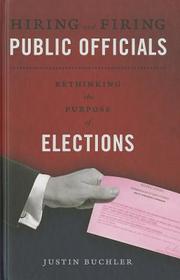
Hiring and Firing Public Officials
Rethinking the Purpose of Elections
- Publisher's listprice GBP 64.00
-
30 576 Ft (29 120 Ft + 5% VAT)
The price is estimated because at the time of ordering we do not know what conversion rates will apply to HUF / product currency when the book arrives. In case HUF is weaker, the price increases slightly, in case HUF is stronger, the price goes lower slightly.
- Discount 10% (cc. 3 058 Ft off)
- Discounted price 27 518 Ft (26 208 Ft + 5% VAT)
Subcribe now and take benefit of a favourable price.
Subscribe
30 576 Ft

Availability
Uncertain availability. Please turn to our customer service.
Why don't you give exact delivery time?
Delivery time is estimated on our previous experiences. We give estimations only, because we order from outside Hungary, and the delivery time mainly depends on how quickly the publisher supplies the book. Faster or slower deliveries both happen, but we do our best to supply as quickly as possible.
Product details:
- Publisher OUP USA
- Date of Publication 25 August 2011
- ISBN 9780199759965
- Binding Hardback
- No. of pages272 pages
- Size 238x169x22 mm
- Weight 480 g
- Language English 0
Categories
Short description:
Conventional theories of elections hold that an election is analogous to a consumer product market. This analogy underlies decades of electoral theory, but in Hiring and Firing Public Officials, Justin Buchler contends that it does not capture the real nature of elections. As Buchler shows, an election is a mechanism by which voters hire and fire public officials. Thus, the health of democracy depends not on regular competitive elections, but on posing a credible threat to
fire public officials who do not perform their jobs well. However, the purpose of that threat is to force public officials to act as faithful public servants so that they do not have to be fired. Thus, competitive elections, by most definitions, are indicative of a failure of the democratic
system.
Long description:
Conventional theories of elections hold that an election is analogous to a consumer product market. According to the market paradigm, voters are consumers, candidates are competing firms, and an election is a market in which voters exchange votes for policy by voting for the candidates whose policies they prefer. According to this logic, a healthy democracy requires frequent competitive elections. The market analogy underlies decades of electoral theory, but in Hiring and Firing
Public Officials, Justin Buchler contends that it does not capture the real nature of elections. In fact, our widespread dissatisfaction with the current state of electoral politics derives from a fundamental misunderstanding of what elections are and what purpose they serve. As Justin Buchler shows, an
election is a mechanism by which voters hire and fire public officials. It is not a consumer product market—it is a single employment decision. Thus, the health of democracy depends not on regular competitive elections, but on posing a credible threat to fire public officials who do not perform their jobs well. However, the purpose of that threat is to force public officials to act as faithful public servants so that they do not have to be fired. Thus, competitive elections, by most
definitions, are indicative of a failure of the democratic system.
Table of Contents:
1. Elections and the Politics of Threats
2. What is Electoral Competition?
3. Elections as Employment Mechanisms
4. Market Competition
5. Electoral Actors in the Market and Employment Models
6. Competitive Elections in the Market and Employment Models
7. Competitive Behavior and Competitive Elections
8. Corruption and Competition
9. Policy Implications of the Market and Employment Models
10. Conclusions
References

