

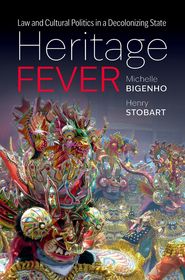
Heritage Fever
Law and Cultural Politics in a Decolonizing State
- Publisher's listprice GBP 22.99
-
10 379 Ft (9 885 Ft + 5% VAT)
The price is estimated because at the time of ordering we do not know what conversion rates will apply to HUF / product currency when the book arrives. In case HUF is weaker, the price increases slightly, in case HUF is stronger, the price goes lower slightly.
- Discount 10% (cc. 1 038 Ft off)
- Discounted price 9 341 Ft (8 897 Ft + 5% VAT)
Subcribe now and take benefit of a favourable price.
Subscribe
10 379 Ft

Availability
Estimated delivery time: In stock at the publisher, but not at Prospero's office. Delivery time approx. 3-5 weeks.
Not in stock at Prospero.
Why don't you give exact delivery time?
Delivery time is estimated on our previous experiences. We give estimations only, because we order from outside Hungary, and the delivery time mainly depends on how quickly the publisher supplies the book. Faster or slower deliveries both happen, but we do our best to supply as quickly as possible.
Product details:
- Publisher OUP USA
- Date of Publication 3 March 2026
- ISBN 9780197756058
- Binding Paperback
- No. of pages248 pages
- Size 226x155x25 mm
- Weight 363 g
- Language English
- Illustrations 16 b&w photos 684
Categories
Short description:
Heritage Fever charts the frenzy of heritage lawmaking that accompanied Bolivia's pro-Indigenous and explicitly decolonizing government under President Evo Morales (2006-19). Through a series of case studies focused on heritage-making individuals who eagerly pursue framing music and dance expressions in formal legislation, the authors reveal dynamics that go far beyond the influence of UNESCO's 2003 Convention for the Safeguarding of the Intangible Cultural Heritage. The book follows the stories of mid-level citizens who engage their state and seek legal legibility for cultural expressions. Heritage-makers' competing claims motivate new knowledge productions and contribute to the country's overall heritage abundance.
MoreLong description:
The early twenty-first century ushered in a period of change in Bolivia. The country welcomed its first Indigenous president, a new constitution, and a profusion of laws that recognized individual music and dance expressions as intangible cultural heritage. Using cultural heritage lawmaking as a window through which to view the de-centered workings of the Indigenous-focused Plurinational Bolivian State, Heritage Fever unpacks the myriad motivations for heritage making in this this politically transformative moment. Heritage Fever reorients UNESCO-driven heritage debates towards a different set of questions--a pivot the authors call “heritage otherwise.”
These inquiries focus on how citizens use law to frame expressive culture and engage their new state. Through grounded case studies, Bigenho and Stobart reveal how competing claims over cultural expressions stimulate aficionado research and produce an abundance of cultural activities. Managing these productive conflicts often involves strategic uses of scale within the country's new political autonomies, even as old-style nationalisms lurk beneath a plurinational sheen. One case study highlights imagined Indigenous autonomy as bolstered by decolonizing historiography that predates the Plurinational State by several decades.
Privileging the stories told by those who championed or who were bureaucratically involved in the respective heritage-making campaigns, Heritage Fever's research draws from the authors' combined fieldwork in Bolivia over the last 30 years, recent multi-sited fieldwork conducted as a team, and ethnographic interviews conducted with Bolivians involved in heritage-making projects. Contributing to legal anthropology, critical heritage studies, ethnomusicology, and anthropology of the state, Heritage Fever looks beyond intellectual property frames, opens new perspectives on archival thinking, reflects on decolonizing practices in expertise and knowledge production, and uncovers the agency of mid-level citizens in a decolonizing state.
Table of Contents:
Introduction: Make Heritage While Decolonizing Shines
Interlude: Keywords for UNESCO Heritage
Chapter 1: Lawfare in a Decolonizing State
Chapter 2: Rocking the Cradle
Chapter 3: "Where There is Blood..."
Chapter 4: Soundscapes of Insurgent Heritage
Conclusion: An Abundance of Laws from Anywhere
References
Index

