

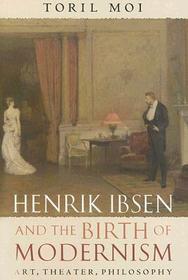
Henrik Ibsen and the Birth of Modernism
Art, Theater, Philosophy
- Publisher's listprice GBP 25.00
-
11 287 Ft (10 750 Ft + 5% VAT)
The price is estimated because at the time of ordering we do not know what conversion rates will apply to HUF / product currency when the book arrives. In case HUF is weaker, the price increases slightly, in case HUF is stronger, the price goes lower slightly.
- Discount 10% (cc. 1 129 Ft off)
- Discounted price 10 159 Ft (9 675 Ft + 5% VAT)
Subcribe now and take benefit of a favourable price.
Subscribe
11 287 Ft

Availability
Uncertain availability. Please turn to our customer service.
Why don't you give exact delivery time?
Delivery time is estimated on our previous experiences. We give estimations only, because we order from outside Hungary, and the delivery time mainly depends on how quickly the publisher supplies the book. Faster or slower deliveries both happen, but we do our best to supply as quickly as possible.
Product details:
- Publisher OUP Oxford
- Date of Publication 3 August 2006
- ISBN 9780199295876
- Binding Hardback
- No. of pages416 pages
- Size 242x165x36 mm
- Weight 778 g
- Language English
- Illustrations 4 colour plates, 10 b/w in-text 0
Categories
Short description:
Published to coincide with the hundredth anniversary of his death, this is a major critical study of Henrik Ibsen by a leading literary theorist. Toril Moi offers a radical reappraisal of Ibsen's place in the birth of modernism and the origins of modern theatre, his influence on other writers, and the connection between his visual imagination and his plays.
MoreLong description:
Henrik Ibsen (1828-1906) is the founder of modern theater, and his plays are performed all over the world. Yet in spite of his unquestioned status as a classic of the stage, Ibsen is often dismissed as a boring old realist, whose plays are of interest only because they remain the gateway to modern theater. In Henrik Ibsen and the Birth of Modernism, Toril Moi makes a powerful case not just for Ibsen's modernity, but also for his modernism.
Henrik Ibsen and the Birth of Modernism situates Ibsen in his cultural context, emphasizes his position as a Norwegian in European culture, and shows how important painting and other visual arts were for his aesthetic education. The book rewrites literary history, reminding modern readers that idealism was the dominant aesthetic paradigm of the nineteenth century. Modernism was born in the ruins of idealism, Moi argues, thus challenging traditional theories of the opposition between
realism and modernism.
By reading Ibsen's modernist plays as investigations of the fate of love in an age of skepticism, Moi shows why Ibsen still matters to us. In this book, Ibsen's plays are showed to be profoundly concerned by theater and theatricality, both on stage and in everyday life. Ibsen's unsettling explorations of women, men, and marriage here emerge as chronicles of the tension between skepticism and the everyday, and between critique and utopia in modernity.
This radical new account places Ibsen in his rightful place alongside Baudelaire, Flaubert, and Manet as a founder of European modernism.
...an illuminating rer-valuation of the influence of aesthetic idealism, a welcome discussion about the need to take back real language in literary criticism, a veritable handbook of imaginative approaches to take to the culture clash of the nineteenth century, a sometimes fruitful, often frustrating, even troubling read for those who have been engaged with Ibsen for a long time...
Table of Contents:
An Ibsen Chronology
Introduction
Part I: Ibsen's Place in History
Ibsen and the Ideology of Modernism
Postcolonial Norway? Ibsen's Cultural Resources
Rethinking Literary History: Idealism, Realism, and the Birth of Modernism
Ibsen's Visual World: Spectacles, Painting, Theater
Part II: Ibsen's Modern Breakthrough
The Idealist Straitjacket: Ibsen's Early Aesthetics
Becoming Modern: Modernity and Theater in Emperor and Galilean
Part III: Ibsen's Modernism: Love in an Age of Skepticism
'First and Foremost a Human Being': Idealism, Theater, and Gender in A Doll's House
Losing Touch with the Everyday: Love and Language in The Wild Duck
Losing Faith in Language: Fantasies of Perfect Communication in Rosmersholm
The Art of Transformation: Art, Marriage, and Freedom in The Lady From the Sea
Epilogue: Idealism and the 'Bad' Everyday
Appendix 1: Synopsis of Emperor and Galilean
Appendix 2: Translating Ibsen

