

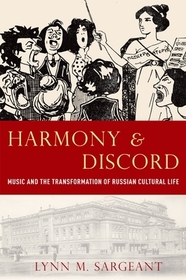
Harmony and Discord
Music and the Transformation of Russian Cultural Life
Series: The New Cultural History of Music Series;
- Publisher's listprice GBP 75.00
-
33 862 Ft (32 250 Ft + 5% VAT)
The price is estimated because at the time of ordering we do not know what conversion rates will apply to HUF / product currency when the book arrives. In case HUF is weaker, the price increases slightly, in case HUF is stronger, the price goes lower slightly.
- Discount 10% (cc. 3 386 Ft off)
- Discounted price 30 476 Ft (29 025 Ft + 5% VAT)
Subcribe now and take benefit of a favourable price.
Subscribe
33 862 Ft

Availability
printed on demand
Why don't you give exact delivery time?
Delivery time is estimated on our previous experiences. We give estimations only, because we order from outside Hungary, and the delivery time mainly depends on how quickly the publisher supplies the book. Faster or slower deliveries both happen, but we do our best to supply as quickly as possible.
Product details:
- Publisher OUP USA
- Date of Publication 3 February 2011
- ISBN 9780199735266
- Binding Hardback
- No. of pages368 pages
- Size 236x155x33 mm
- Weight 617 g
- Language English
- Illustrations 8 tables and 16 halftones 0
Categories
Short description:
Harmony and Discord: Music and the Transformation of Russian Cultural Life explores the complex development of Russian musical life during the nineteenth and early twentieth centuries. Author Lynn M. Sargeant demonstrates that the successful development of a Russian musical infrastructure salved persistent anxieties about Russia's place vis-?-vis its European cultural competitors.
MoreLong description:
Harmony and Discord: Music and the Transformation of Russian Cultural Life explores the complex development of Russian musical life during the nineteenth and early twentieth centuries. At the heart of this cultural history lies the Russian Musical Society, as both a unique driving force behind the institutionalization of music and a representative of the growing importance of voluntary associations in public life. Sustained simultaneously by private initiative and cooperative relationships with the state, the Russian Musical Society played a key role in the creation of Russia's infrastructure for music and music education.
Author Lynn M. Sargeant explores the fluid nature of Russian social identity through the broad scope of musical life, including not only the "leading lights" of the era but also rank-and-file musicians, teachers, and students. Although Russian musicians longed for a secure place within the new hierarchy of professions, their social status remained ambiguous throughout the nineteenth century. Traditional reliance on serf musicians and foreigners left lasting scars that motivated musicians' efforts to obtain legal rights and social respectability. And women's increasing visibility in the musical world provoked acrimonious debates that were, at heart, efforts by male musicians to strengthen their claims to professional status by denying the legitimacy of female participation. Sargeant demonstrates that the successful development of a Russian musical infrastructure salved persistent anxieties about Russia's place vis-?-vis its European cultural competitors. Remarkably, the institutions developed by the Russian Musical Society survived the upheavals of war and revolution to become the foundation for the Soviet musical system.
A wealth of historical documentation makes Harmony and Discord required reading for musicologists, sociologists and historians interested in this period, and the abundance of amusing anecdotes and the author's lucid and lively literary style make it an enjoyable history for all readers.
Lucidly written, thoroughly researched and meticulously documented, Harmony and Discord should be read not just by Russian musicologists, also by cultural and social historians of Russia, and indeed by comparative European historians keen to explore the role played by education and in shaping the national identity of an often misunderstood country.
Table of Contents:
Introduction
A Far From Silent World: Musical Life before the Great Reforms.
Zealots of Culture: The Russian Musical Society, Voluntary Associations, and Cultural Life
The Conservatory in Russian Society: The Institutionalization of Musical Life
Conflicted Identities: The Professionalization of Russian Musical Life
The Geography of Culture: The Expansion of Musical Life in the Provinces
Crisis, Celebration, and the Decline of the Old Cultural Order
Conclusion: Everything Old is New Again
Endnotes
Bibliography
Index

