

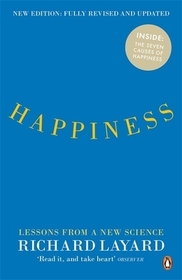
Happiness
Lessons from a New Science (Second Edition)
-
GET 20% OFF
- Publisher's listprice GBP 12.99
-
5 864 Ft (5 585 Ft + 5% VAT)
The price is estimated because at the time of ordering we do not know what conversion rates will apply to HUF / product currency when the book arrives. In case HUF is weaker, the price increases slightly, in case HUF is stronger, the price goes lower slightly.
- Discount 20% (cc. 1 173 Ft off)
- Discounted price 4 691 Ft (4 468 Ft + 5% VAT)
- Discount is valid until: 31 May 2026
4 691 Ft

Availability
Estimated delivery time: In stock at the publisher, but not at Prospero's office. Delivery time approx. 3-5 weeks.
Not in stock at Prospero.
Why don't you give exact delivery time?
Delivery time is estimated on our previous experiences. We give estimations only, because we order from outside Hungary, and the delivery time mainly depends on how quickly the publisher supplies the book. Faster or slower deliveries both happen, but we do our best to supply as quickly as possible.
Product details:
- Edition number Rev. and upd. ed.
- Publisher Penguin Books Ltd
- Date of Publication 7 April 2011
- Number of Volumes B-format paperback
- ISBN 9780241952795
- Binding Paperback
- No. of pages384 pages
- Size 197x132x23 mm
- Weight 278 g
- Language English 0
Categories
Long description:
In this new edition of his landmark book, Richard Layard shows that there is a paradox at the heart of our lives. Most people want more income. Yet as societies become richer, they do not become happier. This is not just anecdotally true, it is the story told by countless pieces of scientific research. We now have sophisticated ways of measuring how happy people are, and all the evidence shows that on average people have grown no happier in the last fifty years, even as average incomes have more than doubled. In fact, the First World has more depression, more alcoholism and more crime than fifty years ago. This paradox is true of Britain, the United States, continental Europe, and Japan. What is going on? Now fully revised and updated to include developments since first publication, Layard answers his critics in what is still the key book in 'happiness studies'.
More
