

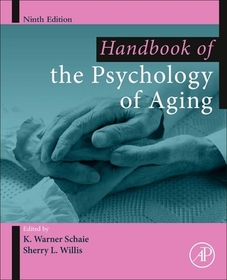
Handbook of the Psychology of Aging
Series: Handbooks of Aging;
- Publisher's listprice EUR 110.00
-
42 966 Ft (40 920 Ft + 5% VAT)
The price is estimated because at the time of ordering we do not know what conversion rates will apply to HUF / product currency when the book arrives. In case HUF is weaker, the price increases slightly, in case HUF is stronger, the price goes lower slightly.
- Discount 20% (cc. 8 593 Ft off)
- Discounted price 34 373 Ft (32 736 Ft + 5% VAT)
- Discount is valid until: 30 June 2026
Subcribe now and take benefit of a favourable price.
Subscribe
42 966 Ft

Availability
printed on demand
Why don't you give exact delivery time?
Delivery time is estimated on our previous experiences. We give estimations only, because we order from outside Hungary, and the delivery time mainly depends on how quickly the publisher supplies the book. Faster or slower deliveries both happen, but we do our best to supply as quickly as possible.
Product details:
- Edition number 9
- Publisher Elsevier Science
- Date of Publication 23 July 2021
- ISBN 9780128160947
- Binding Paperback
- No. of pages382 pages
- Size 276x216 mm
- Weight 1070 g
- Language English 123
Categories
Long description:
Handbook of the Psychology of Aging, Ninth Edition tackles both the biological and environmental influences on behavior and the reciprocal interface between changes in the brain and behavior that span the adult lifespan. This information is very important to many features of daily life, from workplace to family, and in public policy matters. It is complex and new questions are continually raised about how behavior changes with age. Providing perspectives on the behavioral science of aging for diverse disciplines, the handbook explains how the role of behavior is organized and how it changes over the course of life.
Along with parallel advances in research methodology, it explicates in great detail, patterns and sub-patterns of behavior over the lifespan, and how it affects biological, health and social interactions.
MoreTable of Contents:
Part I Concepts, Theories, Methods
1. History of adult cognitive aging research
K. WARNER SCHAIE
2. Measurement and models for multi-timescale psychological processes in aging research
STEVEN M. BOKER AND JOHN R. NESSELROADE
Part II Bio-psychosocial Factors in Aging
3. Functional connectivity in aging
FRANZISKUS LIEM, LINDA GEERLIGS, JESSICA S. DAMOISEAUX AND DANIEL S. MARGULIES
4. Memory: behavior and neural basis
CINDY LUSTIG AND ZIYONG LIN
5. Executive functions and neurocognitive aging
PATRICIA A. REUTER-LORENZ, SARA B. FESTINI AND TIFFANY K. JANTZ
6. Pain in older adults
ANN L. HORGAS AND AMANDA F. ELLIOTT
7. Sleep, neurocognition, and aging, including secular trends in older adult sleep
A. CATHERINE MCCALL AND F. NATHANIELWATSON
8. The final challenge of aging: Death and dying
MOLLY MAXFIELD, EVA-MARIA STELZER AND JEFF GREENBERG
Part III Behavioral Processes
9. Smartphones, robots, and social media: aging with communication technologies
CHENG CHEN, MICHAEL L. KRIEGER AND S. SHYAM SUNDAR
10. Self-perceptions and awareness of aging: past, present, and future
MANFRED DIEHL, ALLYSON F. BROTHERS AND HANS-WERNERWAHL
11. Gender diversity in later life
JENNIFER L. O’ BRIEN AND SUSAN KRAUSS WHITBOURNE
12. Financial decision-making and capacity in older adults
DANIEL C. MARSON, DEBORAH L. KERR AND DONALD G. MCLAREN
13. The older worker: gender and age discrimination in the workplace
STEPHANE P. FRANCIOLI AND MICHAEL S. NORTH
14. Remembering the personal past across adulthood
NICOLE ALEA, SUSAN BLUCK AND SHUBAM SHARMA
Part IV Complex Processes
15. Psychological assessment of neurocognitive disorders
BRIAN P. YOCHIM AND BENJAMIN T. MAST
16. Family care exchanges across the life span
CYNTHIA A. BERG, CAITLIN S. KELLY AND REBECCA L. UTZ
17. Stress, coping, and aging
CAROLYN M. ALDWIN, LORIENA YANCURA AND HYUNYUP LEE
18. Resilience in midlife and aging
KAARIN J. ANSTEY AND ROGER A. DIXON
19. Successful aging: an obscure but obvious construct
RACHEL PRUCHNO
20. Cognitive functioning and dementia prevalence in baby boomers and adjacent cohorts:
Longitudinal and cohort effects
SHERRY L. WILLIS AND K. WARNER SCHAIE

