

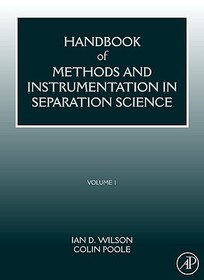
Handbook of Methods and Instrumentation in Separation Science
Volume 1
- Publisher's listprice EUR 149.00
-
58 199 Ft (55 428 Ft + 5% VAT)
The price is estimated because at the time of ordering we do not know what conversion rates will apply to HUF / product currency when the book arrives. In case HUF is weaker, the price increases slightly, in case HUF is stronger, the price goes lower slightly.
- Discount 10% (cc. 5 820 Ft off)
- Discounted price 52 379 Ft (49 885 Ft + 5% VAT)
Subcribe now and take benefit of a favourable price.
Subscribe
58 199 Ft

Availability
printed on demand
Why don't you give exact delivery time?
Delivery time is estimated on our previous experiences. We give estimations only, because we order from outside Hungary, and the delivery time mainly depends on how quickly the publisher supplies the book. Faster or slower deliveries both happen, but we do our best to supply as quickly as possible.
Product details:
- Publisher Elsevier Science
- Date of Publication 1 October 2009
- ISBN 9780123750952
- Binding Hardback
- No. of pages880 pages
- Size 279x203 mm
- Weight 2380 g
- Language English 0
Categories
Long description:
Handbook of Methods and Instrumentation in Separation Science, Volume 1 provides concise overviews and summaries of the main methods used for separation. It is based on the Encyclopedia of Separation Science. The handbook focuses on the principles of methods and instrumentation. It provides general concepts concerning the subject matter; it does not present specific procedures.
This volume discusses the separation processes including affinity methods, analytical ultracentrifugation, centrifugation, chromatography, and use of decanter centrifuge and dye. Each methodology is defined and compared with other separation processes. It also provides specific techniques, principles, and theories concerning each process. Furthermore, the handbook presents the applications, benefits, and validation of the processes described in this book.
This handbook is an excellent reference for biomedical researchers, environmental and production chemists, flavor and fragrance technologists, food and beverage technologists, academic and industrial librarians, and nuclear researchers. Students and novices will also find this handbook useful for practice and learning.
MoreTable of Contents:
Affinity Separations
Centrifugation
Chromatography

