

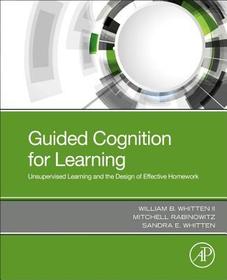
Guided Cognition for Learning
Unsupervised Learning and the Design of Effective Homework
- Publisher's listprice EUR 87.95
-
34 353 Ft (32 717 Ft + 5% VAT)
The price is estimated because at the time of ordering we do not know what conversion rates will apply to HUF / product currency when the book arrives. In case HUF is weaker, the price increases slightly, in case HUF is stronger, the price goes lower slightly.
- Discount 10% (cc. 3 435 Ft off)
- Discounted price 30 918 Ft (29 445 Ft + 5% VAT)
Subcribe now and take benefit of a favourable price.
Subscribe
34 353 Ft

Availability
printed on demand
Why don't you give exact delivery time?
Delivery time is estimated on our previous experiences. We give estimations only, because we order from outside Hungary, and the delivery time mainly depends on how quickly the publisher supplies the book. Faster or slower deliveries both happen, but we do our best to supply as quickly as possible.
Product details:
- Publisher Elsevier Science
- Date of Publication 22 May 2019
- ISBN 9780128175385
- Binding Paperback
- No. of pages218 pages
- Size 234x190 mm
- Weight 450 g
- Language English 0
Categories
Long description:
Guided Cognition for Learning: Unsupervised Learning and the Design of Effective Homework details a new instructional design approach called Guided Cognition where homework tasks are designed to guide learners to engage in specific, observable cognitive events that are hypothesized to elicit underlying theoretical cognitive processes that result in learning. Outlining the results of twenty-six experiments completed over the course of eight years, the book tells a significant story about the generality of Guided Cognition instructional design to improve comprehension and recall by students of varying ages and ability levels.
MoreTable of Contents:
1. The Importance of Unsupervised Individual Learning in Education2. Guided Cognition: A New Approach to Designing Effective Homework3. Guided Cognition Effects in Learning Literature4. Guided Cognition Effects in Learning Mathematics5. Students' Perceptions and Preferences6. Theoretical Considerations7. Improving Unsupervised Individual Learning8. Benefits and Applications of Guided Cognition Design
More
