

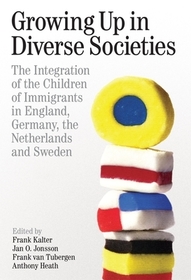
Growing up in Diverse Societies
The Integration of the Children of Immigrants in England, Germany, the Netherlands, and Sweden
Series: Proceedings of the British Academy; 215;
- Publisher's listprice GBP 85.00
-
38 377 Ft (36 550 Ft + 5% VAT)
The price is estimated because at the time of ordering we do not know what conversion rates will apply to HUF / product currency when the book arrives. In case HUF is weaker, the price increases slightly, in case HUF is stronger, the price goes lower slightly.
- Discount 10% (cc. 3 838 Ft off)
- Discounted price 34 540 Ft (32 895 Ft + 5% VAT)
Subcribe now and take benefit of a favourable price.
Subscribe
38 377 Ft

Availability
Estimated delivery time: In stock at the publisher, but not at Prospero's office. Delivery time approx. 3-5 weeks.
Not in stock at Prospero.
Why don't you give exact delivery time?
Delivery time is estimated on our previous experiences. We give estimations only, because we order from outside Hungary, and the delivery time mainly depends on how quickly the publisher supplies the book. Faster or slower deliveries both happen, but we do our best to supply as quickly as possible.
Product details:
- Publisher OUP Oxford
- Date of Publication 4 October 2018
- ISBN 9780197266373
- Binding Hardback
- No. of pages424 pages
- Size 241x163x30 mm
- Weight 816 g
- Language English
- Illustrations Numerous graphs and tables 0
Categories
Short description:
Growing up in Diverse Societies offers an assessment of the lives and attitudes of young ethnic minorities. Using recent data on c. 19,000 adolescents in England, Germany, the Netherlands, and Sweden, the editors have compared minorities and the majority revealing patterns of integration across immigrant origins and destination countries.
MoreLong description:
Growing up in Diverse Societies provides a comprehensive analysis of the integration of children of immigrants in England, Germany, the Netherlands and Sweden. It is based on the Children of Immigrants Longitudinal Survey in Four European Countries (CILS4EU), which included harmonised interviews with almost 19,000 14-15-year-olds. Growing up in Diverse Societies studies the life situation, social relations, and attitudes of adolescents in different ethnic minority groups, and compares these systematically to the majority youth in the four countries. The chapters cover a wide range of aspects of integration, all addressing comparisons between origin groups, generations, and destination countries, and elucidating processes accounting for differences.
The results challenge much of the current thinking on the state of integration. In some respects, such as own economic means, delinquency, and mental health, children of immigrants are surprisingly similar to majority youth, while in other respects there are large dissimilarities. There are also substantial differences between ethnic minority groups, with the economic and cultural distance of the origin regions to the destination country being a key factor. For some outcomes, such as language proficiency or host country identification, dissimilarities seem to narrow over generations, but this does not hold for other outcomes, such as religiosity and attitudes. Remaining differences partly depend on ethnic segregation, some on socioeconomic inequality, and others on parental influences. Most interestingly, Growing up in Diverse Societies finds that the four destination countries, though different in their immigration histories, policy approaches, and contextual conditions, are on the whole rather similar in the general patterns of integration and in the underlying processes.
Table of Contents:
Notes on Contributors
Acknowledgements
Part I: Setting up the Study
Studying Minority and Majority Youth in Comparative Perspective
Immigration and Integration: Key Characteristics of Host Countries and Their Immigrants
Dealing with Diverse Diversities: Defining and Comparing Minority Groups
Part II: Structural Integration
Keeping up with the Smiths, M--llers, De Jongs, and Johanssons - The Economic Situation of Minority and Majority Youth
Learning Together or Apart? Ethnic Segregation in Lower Secondary Schools
Part III: Social Integration
The Cat's in the Cradle: Family Structure and Father Absence among Immigrant Children
Making Friends across Ethnic Boundaries: Are Personal Networks of Adolescents Diverse?
Social Contact and Interethnic Attitudes: The Importance of Contact Experiences in Schools
Part IV: Cultural Integration
Ethnic Differences in Language Skills: How Individual and Family Characteristics Aid in and Prohibit the Linguistic Integration of the Children of Immigrants
Keeping or Losing the Faith? Comparing Religion across Majority and Minority Youth in Europe
Young People in Transition: The National Identity of Minority Youth
Ethnic Minority Youth at the Crossroads: Between Traditionalism and Liberal Value Orientations
Part V: Further Aspects of Integration
Reconsidering the Immigration-Crime nexus in Europe: Ethnic Differences in Juvenile Delinquency
Mental Well-being in Boys and Girls of Immigrant Background: The Balance between Vulnerability and Resilience

