

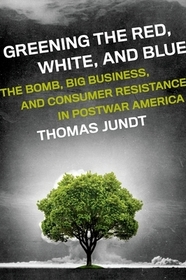
Greening the Red, White, and Blue
The Bomb, Big Business, and Consumer Resistance in Postwar America
- Publisher's listprice GBP 46.49
-
20 990 Ft (19 990 Ft + 5% VAT)
The price is estimated because at the time of ordering we do not know what conversion rates will apply to HUF / product currency when the book arrives. In case HUF is weaker, the price increases slightly, in case HUF is stronger, the price goes lower slightly.
- Discount 10% (cc. 2 099 Ft off)
- Discounted price 18 891 Ft (17 991 Ft + 5% VAT)
Subcribe now and take benefit of a favourable price.
Subscribe
20 990 Ft

Availability
printed on demand
Why don't you give exact delivery time?
Delivery time is estimated on our previous experiences. We give estimations only, because we order from outside Hungary, and the delivery time mainly depends on how quickly the publisher supplies the book. Faster or slower deliveries both happen, but we do our best to supply as quickly as possible.
Product details:
- Publisher OUP USA
- Date of Publication 5 June 2014
- ISBN 9780199791200
- Binding Hardback
- No. of pages322 pages
- Size 236x160x30 mm
- Weight 544 g
- Language English 0
Categories
Short description:
Atomic weapons awakened humanity to the realization that it could annihilate the planet. It was soon recognized that corporate capitalism might also destroy the earth. This book explores how citizens, unable to achieve adequate political solutions through a government aligned with big business, turned to their actions as consumers to try to effect change.
MoreLong description:
Although often linked to Rachel Carson's Silent Spring (1962), and Sixties era social movement, environmentalism arose in response to anxieties and tensions over the fate of the planet that first came to light with the atomic bomb blasts and the end of the Second World War that moved some thinkers to ponder other ways that humans might be endangering the planet. Their focus turned to the growing power of big business. More than ever, powerful corporations and a federal government bent on economic growth were seen by many Americans as threats to human health and the environment. Fallout from atomic testing, air and water pollution, the proliferation of pesticides and herbicides-all connected to the growing dominance of technology and corporate capitalism in American life-led a variety of constituencies to seek solutions in what came to be known as environmentalism.
In addition to the usual political and legal maneuvers employed to effect change, an alternative form of civic participation emerged beginning in the late-1940s as growing numbers of citizens turned to what they deemed environmentally friendly consumption practices. The goal of this politically charged consumption was not only to protect themselves and their families from harm, but to achieve social change at a time when many Americans believed the polity was increasingly out of balance, with government placing the desires of business before the needs of its citizens. Politicians responded to the growing environmental concerns of middle class Americans, but, in the end, continual political compromises with corporate power meant weak laws and lax enforcement. Many citizens sought refuge in an alternative "green" marketplace-an attempt to find a space within an imagined community of others who shared their concerns and frustrations, as well as their vision for a different American Way.
Greening the Red, White, and Blue carefully demonstrates that an environmental consciousness developed earlier than is commonly assumed, in the postwar years rather than the 1960s. By examining reactions to atomic testing, pesticides, concerns about air pollution, and increasing corporate power, Thomas Jundt expertly traces the many paths that Americans took on the way to environmental consciousness. This book nicely shows the ways in which American consumers were both complicit and critical in dealing with the environmental challenges of the postwar world.
Table of Contents:
Acknowledgments
Introduction: Shopping As If Their Lives (and the Planet's) Depended on It
Part I: A New Era
1. "Sons of Bitches": Sources of Postwar Anxiety
2. Green Consumption in a Dangerous World
3. Downwinders
4. Chemicals and Romance
Part II: A New Response
5. "A Ground Swell of Public Indignation"
6. The 'New' Conservation
7. "Striking Back at the Goddam Sons of Bitches"
8. Green Consumption Goes Mainstream
Conclusion: "The Clock is Ticking"
Notes
Index

