

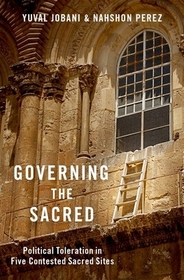
Governing the Sacred
Political Toleration in Five Contested Sacred Sites
- Publisher's listprice GBP 96.00
-
43 344 Ft (41 280 Ft + 5% VAT)
The price is estimated because at the time of ordering we do not know what conversion rates will apply to HUF / product currency when the book arrives. In case HUF is weaker, the price increases slightly, in case HUF is stronger, the price goes lower slightly.
- Discount 20% (cc. 8 669 Ft off)
- Discounted price 34 675 Ft (33 024 Ft + 5% VAT)
- Discount is valid until: 30 June 2026
Subcribe now and take benefit of a favourable price.
Subscribe
43 344 Ft

Availability
Estimated delivery time: In stock at the publisher, but not at Prospero's office. Delivery time approx. 3-5 weeks.
Not in stock at Prospero.
Why don't you give exact delivery time?
Delivery time is estimated on our previous experiences. We give estimations only, because we order from outside Hungary, and the delivery time mainly depends on how quickly the publisher supplies the book. Faster or slower deliveries both happen, but we do our best to supply as quickly as possible.
Product details:
- Publisher OUP USA
- Date of Publication 22 June 2020
- ISBN 9780190932381
- Binding Hardback
- No. of pages212 pages
- Size 163x246x27 mm
- Weight 476 g
- Language English 14
Categories
Short description:
Holy sites are often at the center of intense contestation between different groups regarding a wide variety of issues, including ownership, access, usage rights, permissible religious conduct, and others. They are often the source of intractable long-standing conflicts and extreme violence. These difficulties are exemplified by the five sites profiled in Governing the Sacred : Devils Tower National Monument (Wyoming, US), Babri Masjid/Ram Janmabhoomi (Uttar-Pradesh, India), the Western Wall (Jerusalem), the Church of the Holy Sepulchre (Jerusalem), and the Temple Mount/Haram esh-Sharif (Jerusalem).
MoreLong description:
Holy sites are often at the center of intense contestation between different groups regarding a wide variety of issues, including ownership, access, usage rights, permissible religious conduct, and many others. They are often the source of intractable long-standing conflicts and extreme violence.
These difficulties are exemplified by the five sites profiled in Governing the Sacred : Devils Tower National Monument (Wyoming, US), Babri Masjid/Ram Janmabhoomi (Uttar-Pradesh, India), the Western Wall (Jerusalem), the Church of the Holy Sepulchre (Jerusalem), and the Temple Mount/Haram esh-Sharif (Jerusalem). Telling the fascinating stories of these high-profile contested sites, the authors develop and critically explore five different models of governing such sites: "non-interference," "separation and division," "preference," "status-quo," and "closure."
Each model relies on different sets of considerations; central among them are trade-offs between religious liberty and social order. This novel typology aims to assist democratic governments in their attempt to secure public order and mutual toleration among opposed groups in contested sacred sites.
very compelling
Table of Contents:
Introduction
Chapter 1: Basic concepts and strategies of inquiry
Chapter 2: Devils Tower National Monument/Bear Lodge (Wyoming): on non-interference at contested sacred sites
Chapter 3: Ram Janmabhoomi/Babri Masjid (Uttar Pradesh): 'separation and division' at contested sacred sites
Chapter 4: The Western Wall: State Preference at Contested Sacred Sites
Chapter 5: The Church of the Holy Sepulchre and the Temple Mount/Haram esh-Sharif (Jerusalem): status quo and closure at contested sacred sites
Conclusion: Political toleration in contested sacred sites

