

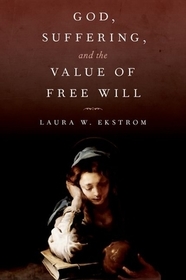
God, Suffering, and the Value of Free Will
- Publisher's listprice GBP 98.00
-
44 247 Ft (42 140 Ft + 5% VAT)
The price is estimated because at the time of ordering we do not know what conversion rates will apply to HUF / product currency when the book arrives. In case HUF is weaker, the price increases slightly, in case HUF is stronger, the price goes lower slightly.
- Discount 10% (cc. 4 425 Ft off)
- Discounted price 39 822 Ft (37 926 Ft + 5% VAT)
Subcribe now and take benefit of a favourable price.
Subscribe
44 247 Ft

Availability
printed on demand
Why don't you give exact delivery time?
Delivery time is estimated on our previous experiences. We give estimations only, because we order from outside Hungary, and the delivery time mainly depends on how quickly the publisher supplies the book. Faster or slower deliveries both happen, but we do our best to supply as quickly as possible.
Product details:
- Publisher OUP USA
- Date of Publication 30 July 2021
- ISBN 9780197556412
- Binding Hardback
- No. of pages248 pages
- Size 155x239x25 mm
- Weight 454 g
- Language English 108
Categories
Short description:
For many of us, the issue of whether or not God exists is among the most perplexing and profound questions of our lives. Laura Ekstrom examines this issue in light of ubiquitous human suffering. When we survey the world, we observe an enormous amount of pain, including virtually unspeakable kinds of maltreatment and agony, many instances of which seem patently to be unfair, unearned, and pointless. In light of these observations, this book argues that it is reasonable to conclude that God does not exist. Ekstrom shows the power of arguments from evil for atheism, while giving a thorough critical examination of attempts to answer them.
MoreLong description:
For many of us, the question of whether or not God exists is one of the most perplexing and profound questions of our lives, and numerous philosophers and theologians have debated it for centuries. Laura Ekstrom here takes a new look at the issue of God's existence by examining it against the reality of human suffering, bringing to the fore contentious presuppositions concerning agency and value at the core of the matter. When we survey the world, we observe an enormous amount of pain, including virtually unspeakable kinds of maltreatment and agony, many instances of which seem patently unfair, unearned, and pointless. This book argues that, in light of these observations, it is reasonable to conclude that God does not exist.
The book unravels the extent and power of arguments from evil. Ekstrom provides a close investigation of a largely overlooked claim at the heart of major free-will-based responses to such arguments, namely that free will is worth it: sufficiently valuable to serve as the good that provides a God-justifying reason for permitting evil in the world. Through fresh examinations of traditional theodicies, Ekstrom develops an alternative line called divine intimacy theodicy, and makes an extended case for rejecting skeptical theism. The book takes up an argument from evil concerning a traditional doctrine of hell, which reveals a number of compelling issues concerning fault, agency, and blameworthiness. In response to recent work contending that the problem of evil is toothless because God is indifferent to human beings, Ekstrom defends the essential perfect moral goodness of God. She further tackles the question of whether or not it is possible to live a religious life as an agnostic or as an atheist.
Through rigorous reflection, with deep respect for religious thought and experience, and with sensitivity to the range and kinds of suffering so many endure, Ekstrom firmly advances discussion of the problem of evil and paves the way for further scholarship in the philosophy of religion.
Ekstrom's writings focus on issues of responsibility and free will. This book explores philosophical attempts to reconcile God's existence with the existence of suffering and evil....Ekstrom's writing is lucid, and she presents complex philosophical ideas with clarity, looking at the works of those with whom she disagrees charitably and giving them the strongest possible reading. She also argues for paying attention to emotional knowledge and treating evil not simply as a logical problem. This is an important book for students of the philosophy of religion...Summing Up: Recommended. Upper-division undergraduates; graduate students.
Table of Contents:
Introduction
Chapter 1: God and Suffering
Chapter 2: The Value of Free Will
Chapter 3: Divine Intimacy Theodicy
Chapter 4: Skeptical Theism
Chapter 5: Hell and Fault
Chapter 6: God's Ethics: A Workaround?
Chapter 7: Religion on the Cheap
Chapter 8: Conclusion

