

- Publisher's listprice GBP 14.99
-
6 767 Ft (6 445 Ft + 5% VAT)
The price is estimated because at the time of ordering we do not know what conversion rates will apply to HUF / product currency when the book arrives. In case HUF is weaker, the price increases slightly, in case HUF is stronger, the price goes lower slightly.
- Discount 10% (cc. 677 Ft off)
- Discounted price 6 091 Ft (5 801 Ft + 5% VAT)
Subcribe now and take benefit of a favourable price.
Subscribe
6 767 Ft

Availability
Estimated delivery time: In stock at the publisher, but not at Prospero's office. Delivery time approx. 3-5 weeks.
Not in stock at Prospero.
Why don't you give exact delivery time?
Delivery time is estimated on our previous experiences. We give estimations only, because we order from outside Hungary, and the delivery time mainly depends on how quickly the publisher supplies the book. Faster or slower deliveries both happen, but we do our best to supply as quickly as possible.
Product details:
- Publisher Bloomsbury Publishing (UK)
- Date of Publication 21 November 2024
- Number of Volumes Paperback
- ISBN 9781472862761
- Binding Paperback
- No. of pages64 pages
- Size 246x184x6 mm
- Weight 220 g
- Language English
- Illustrations 8 colour artwork plates; black & white and colour photographs and illustrations. 556
Categories
Long description:
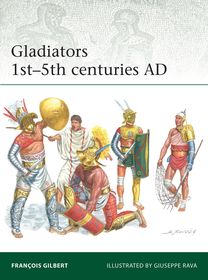
This illustrated study lifts the veil on the gladiators of ancient Rome, who provided a bloody spectacle for the people of the Eternal City and its vast empire.
By the start of the Principate in 27 BC, the gladiator games were a long-standing part of the social and political life of Rome and its sprawling empire. In the wake of reforms enacted by Augustus, the games continued to be at the heart of Roman culture and politics during the 1st and 2nd centuries AD.
While prominent citizens harnessed the opportunities offered by the gladiator games to enhance their own reputations and reward their clients, the emperors soon assumed a near-monopoly on the provision of games; several even entered the arena themselves, most notoriously Commodus. In the quest for novelty, prisoners, criminals and women came to participate in this grisly 'sport'. Only after the adoption of Christianity as the state religion in AD 380 did armed combat between gladiators enter a decline, and even then beast hunts persisted into the 6th century.
Although much evidence remains, both literary and archaeological, the gladiators and their world continue to be misunderstood. Featuring full-colour reconstructions of these legendary arena fighters, this book draws upon the latest research and the author's own findings to cast new light on these formidable arena fighters and their legacy.
Table of Contents:
Evolution and decline
The gladiators
The armaturae
Gladiator gear
Bibliography
Index

