

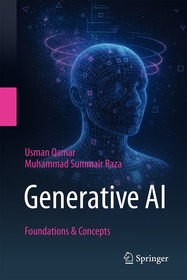
Generative AI
Foundations & Concepts
-
GET 12% OFF
- Publisher's listprice EUR 80.24
-
31 341 Ft (29 849 Ft + 5% VAT)
The price is estimated because at the time of ordering we do not know what conversion rates will apply to HUF / product currency when the book arrives. In case HUF is weaker, the price increases slightly, in case HUF is stronger, the price goes lower slightly.
- Discount 12% (cc. 3 761 Ft off)
- Discounted price 27 580 Ft (26 267 Ft + 5% VAT)
27 580 Ft

Availability
Not yet published.
Why don't you give exact delivery time?
Delivery time is estimated on our previous experiences. We give estimations only, because we order from outside Hungary, and the delivery time mainly depends on how quickly the publisher supplies the book. Faster or slower deliveries both happen, but we do our best to supply as quickly as possible.
Product details:
- Publisher Springer Nature Singapore
- Date of Publication 9 August 2026
- ISBN 9789819513772
- Binding Hardback
- No. of pages652 pages
- Size 235x155 mm
- Language English
- Illustrations XXVI, 652 p. 346 illus., 33 illus. in color. 700
Categories
Long description:
This textbook covers the foundations, concepts, and implementations of Generative AI. It offers students with the knowledge and skills essential for the evolving field of Generative AI. It covers both the theory and the practical implementation, and every concept is explained with simple and easy-to-understand examples. The implementation of each generative AI model is also part of the textbook.
The textbook consists of four parts. Part 1 which consists of two chapters is an introduction to Generative AI. It provides an exploration of the fundamental concepts underlying the field of generative Artificial Intelligence. It builds a strong foundation for the reader to understand the remaining parts. In the Part 2, all the core concepts of Generative AI like Variational Autoencoders, Generative Adversarial Networks, Normalizing Flow Models Autoregressive Models, Energy-based and Diffusion Models and Large Language Models (LLMs) are covered. In Part 3, applications of Generative AI including World Models, Content Generation with Generative Models and Building Applications with LLMs are discussed. Finally, Part 4, looks at the ethical considerations for the development and deployment of Generative AI models. Chapter-wise complete source codes are delivered as an additional resource. Practical exercises are also included at the end of each chapter.
The textbook was specifically written to enable the teaching of both basic and advanced concepts from one single book. The book is suitable for both undergraduate and graduate students in computer science and engineering. This textbook is a valuable resource for students who want to study the domain of Generative AI.
MoreTable of Contents:
"
""Part 1-Introduction to Generative AI"".- ""Chapter 1- Generative Modeling"".- ""Chapter 2-Deep Learning Concepts"".- ""Part 2-Generative AI Methods"".- ""Chapter 3-Variational Autoencoders"".- ""Chapter 4-Generative Adversarial Networks"".- ""Chapter 5- Autoregressive Models"".- ""Chapter 6-Normalizing Flow Models"".- ""Chapter 7-Energy based and Diffusion Models"".- ""Chapter 8- Advanced GANs"".- ""Chapter 9-Large Language Models"".- ""Part 4- Applications of Generative AI"".- ""Chapter 10-Content Generation with Generative Models"".- ""Chapter 11- World Model"".- ""Chapter 12-Building Applications with LLMs"".-""Part-1Chapter 13-Building Applications with LLMs"".- ""Part-2Part 5-Generative AI Ethics"".- ""Chapter 14: Ethics of Generative AI"".
" More
