

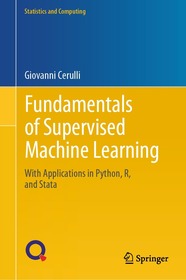
Fundamentals of Supervised Machine Learning
With Applications in Python, R, and Stata
Series: Statistics and Computing;
- Publisher's listprice EUR 128.39
- Prospero’s price EUR 89.99
-
35 150 Ft (33 476 Ft + 5% VAT)
The price is estimated because at the time of ordering we do not know what conversion rates will apply to HUF / product currency when the book arrives. In case HUF is weaker, the price increases slightly, in case HUF is stronger, the price goes lower slightly.
- Discount 20% (cc. 7 030 Ft off)
- Discounted price 28 120 Ft (26 781 Ft + 5% VAT)
- Discount is valid until: 30 June 2026
Subcribe now and take benefit of a favourable price.
Subscribe
30 932 Ft

Availability
printed on demand
Why don't you give exact delivery time?
Delivery time is estimated on our previous experiences. We give estimations only, because we order from outside Hungary, and the delivery time mainly depends on how quickly the publisher supplies the book. Faster or slower deliveries both happen, but we do our best to supply as quickly as possible.
Product details:
- Edition number 1st ed. 2023
- Publisher Springer International Publishing
- Date of Publication 15 November 2023
- Number of Volumes 1 pieces, Book
- ISBN 9783031413360
- Binding Hardback
- No. of pages391 pages
- Size 235x155 mm
- Weight 876 g
- Language English
- Illustrations XXIX, 391 p. 144 illus., 99 illus. in color. Illustrations, black & white 454
Categories
Long description:
This book presents the fundamental theoretical notions of supervised machine learning along with a wide range of applications using Python, R, and Stata. It provides a balance between theory and applications and fosters an understanding and awareness of the availability of machine learning methods over different software platforms.
After introducing the machine learning basics, the focus turns to a broad spectrum of topics: model selection and regularization, discriminant analysis, nearest neighbors, support vector machines, tree modeling, artificial neural networks, deep learning, and sentiment analysis. Each chapter is self-contained and comprises an initial theoretical part, where the basics of the methodologies are explained, followed by an applicative part, where the methods are applied to real-world datasets. Numerous examples are included and, for ease of reproducibility, the Python, R, and Stata codes used in the text, along with the related datasets, are available online.
The intended audience is PhD students, researchers and practitioners from various disciplines, including economics and other social sciences, medicine and epidemiology, who have a good understanding of basic statistics and a working knowledge of statistical software, and who want to apply machine learning methods in their work.
More
Table of Contents:
Preface.- The Ontology of Machine Learning.- The Statistics of Machine Learning.- Model Selection and Regularization.- Discriminant Analysis, Nearest Neighbor and Support Vector Machines.- Tree Modelling.- Artificial Neural Networks.- Deep Learning.- Sentiment Analysis.- Index.

