

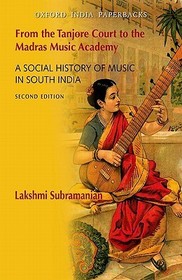
From the Tanjore Court to the Madras Music Academy
A Social History of Music in South India
- Publisher's listprice GBP 11.99
-
5 413 Ft (5 155 Ft + 5% VAT)
The price is estimated because at the time of ordering we do not know what conversion rates will apply to HUF / product currency when the book arrives. In case HUF is weaker, the price increases slightly, in case HUF is stronger, the price goes lower slightly.
- Discount 10% (cc. 542 Ft off)
- Discounted price 4 871 Ft (4 640 Ft + 5% VAT)
Subcribe now and take benefit of a favourable price.
Subscribe
5 413 Ft

Availability
Only to order.
Why don't you give exact delivery time?
Delivery time is estimated on our previous experiences. We give estimations only, because we order from outside Hungary, and the delivery time mainly depends on how quickly the publisher supplies the book. Faster or slower deliveries both happen, but we do our best to supply as quickly as possible.
Product details:
- Publisher OUP India
- Date of Publication 10 March 2011
- ISBN 9780198071907
- Binding Paperback
- No. of pages232 pages
- Size 216x141x11 mm
- Weight 248 g
- Language English
- Illustrations 4 Halftones 0
Categories
Short description:
This book deals with the production of knowledge about music and the related institution-building process in south India. It also examines the role of identity, imagination, nationalism, and patronage in the development of musical tradition in south India.
MoreLong description:
This book traces the adaptation of the traditional music in south India, from the quiet courtyards of Tanjore to the concert halls of Madras, to the necessities of colonial and post-colonial social realities. An engaging narrative of the production of knowledge about music and the related institution-building process, the volume raises larger questions of identity and imagination. It discusses the influence of nationalism in the creation of an auditory habit as much as it shows how performance and patronage influenced the self-development of the consuming elite. Anticipating the dilemmas of the emerging modern Indian middle class, the author also explores the ambivalence and ambiguities that informed musical practices in the nineteenth and twentieth centuries. The second edition carries a new introduction which updates research on the subject and also discusses the new issues and trends emerging in the study of south Indian classical music.
This book will interest students and scholars of history, music, sociology, ethnomusicology, cultural studies, south India, as well as informed general readers.
This study is an engaging and fascinating read, of interest to scholars and students well beyond the geographical boundaries of the book.
Table of Contents:
Preface and Acknowledgements; List of Illustrations; Introduction; Chapter 1. Music Comes to the City; Chapter 2. Defining the Classical: The Nationalist Imperative; Chapter 3. Consolidating the Classical: The Madras Music Academy and the Politics of Custodianship; Chapter 4. On the Margins of the Classical: Law, Social Reform, and the Devadasis in the Madras Presidency; Chapter 5. Contesting the Classical: The Tamil Isai Iyakkam and the Contest for Custodianship; Epilogue; Bibliography; Index.
More
