

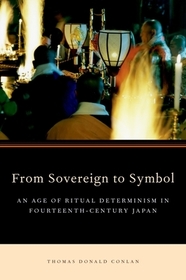
From Sovereign to Symbol
An Age of Ritual Determinism in Fourteenth Century Japan
- Publisher's listprice GBP 102.50
-
46 278 Ft (44 075 Ft + 5% VAT)
The price is estimated because at the time of ordering we do not know what conversion rates will apply to HUF / product currency when the book arrives. In case HUF is weaker, the price increases slightly, in case HUF is stronger, the price goes lower slightly.
- Discount 10% (cc. 4 628 Ft off)
- Discounted price 41 651 Ft (39 668 Ft + 5% VAT)
Subcribe now and take benefit of a favourable price.
Subscribe
46 278 Ft

Availability
printed on demand
Why don't you give exact delivery time?
Delivery time is estimated on our previous experiences. We give estimations only, because we order from outside Hungary, and the delivery time mainly depends on how quickly the publisher supplies the book. Faster or slower deliveries both happen, but we do our best to supply as quickly as possible.
Product details:
- Publisher OUP USA
- Date of Publication 26 January 2012
- ISBN 9780199778102
- Binding Hardback
- No. of pages256 pages
- Size 165x239x22 mm
- Weight 499 g
- Language English
- Illustrations 10 b&w; 3 maps 0
Categories
Short description:
Fourteenth-century Japan witnessed a conflict about the nature of power that was expressed through the rituals and institutions of two rival courts. Ultimately, political authority came to be asserted through the language of esoteric Buddhist rituals, which determined the parameters of political possibility in Japan.
MoreLong description:
Fourteenth-century Japan witnessed a fundamental political and intellectual conflict about the nature of power and society, a conflict that was expressed through the rituals and institutions of two rival courts. Rather than understanding the collapse of Japan's first warrior government (the Kamakura bakufu) and the onset of a chaotic period of civil war as the manipulation of rival courts by powerful warrior factions, this study argues that the crucial ideological and intellectual conflict of the fourteenth century was between the conservative forces of ritual precedent and the ritual determinists steeped in Shingon Buddhism. Members of the monastic nobility who came to dominate the court used the language of Buddhist ritual, including incantations (mantras), gestures (mudras), and "cosmograms" (mandalas projected onto the geography of Japan) to uphold their bids for power. Sacred places that were ritual centers became the targets of military capture precisely because they were ritual centers. Ritual was not simply symbolic; rather, ritual became the orchestration, or actual dynamic, of power in itself. This study undermines the conventional wisdom that Zen ideals linked to the samurai were responsible for the manner in which power was conceptualized in medieval Japan, and instead argues that Shingon ritual specialists prolonged the conflict and enforced the new notion that loyal service trumped the merit of those who simply requested compensation for their acts. Ultimately, Shingon mimetic ideals enhanced warrior power and enabled Shogun Ashikaga Yoshimitsu, rather than the reigning emperor, to assert sovereign authority in Japan.
ThomasDonald Conlan is a productive and respected historian of medieval Japan and he has directed his attention to the fourteenth cntury in this fascinating study. ... We can only hope that this fascinating study will inspire more scholars to consider the powerful role of Kenshun and his rituals in the highest echelons of Japanese society in the mid-fourteenth century.
Table of Contents:
Prologue
Introduction
Chapter 1: The Rise of the Administrative Nobility
Chapter 2: Kitabatake Chikafusa and the Unveiling of Court Secrets
Chapter 3: The Master of Ritual
Chapter 4: The Destruction of Precedent
Chapter 5: Creating Court and Sovereign
Chapter 6: The End of the Past
Chapter 7: The Ashikaga Emperor
Epilogue: The Unraveling
Glossary
Bibliography

