

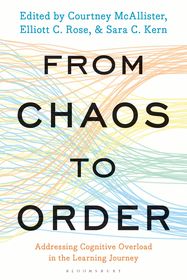
From Chaos to Order
Addressing Cognitive Overload in the Learning Journey
- Publisher's listprice GBP 49.99
-
22 570 Ft (21 495 Ft + 5% VAT)
The price is estimated because at the time of ordering we do not know what conversion rates will apply to HUF / product currency when the book arrives. In case HUF is weaker, the price increases slightly, in case HUF is stronger, the price goes lower slightly.
- Discount 20% (cc. 4 514 Ft off)
- Discounted price 18 056 Ft (17 196 Ft + 5% VAT)
- Discount is valid until: 30 June 2026
Subcribe now and take benefit of a favourable price.
Subscribe
22 570 Ft

Availability
Estimated delivery time: In stock at the publisher, but not at Prospero's office. Delivery time approx. 3-5 weeks.
Not in stock at Prospero.
Why don't you give exact delivery time?
Delivery time is estimated on our previous experiences. We give estimations only, because we order from outside Hungary, and the delivery time mainly depends on how quickly the publisher supplies the book. Faster or slower deliveries both happen, but we do our best to supply as quickly as possible.
Product details:
- Publisher Bloomsbury Publishing (UK)
- Date of Publication 16 April 2026
- ISBN 9781538190241
- Binding Paperback
- No. of pages344 pages
- Size 226x152x24 mm
- Weight 560 g
- Language English
- Illustrations 44 bw illus 696
Categories
Short description:
This book explores the multifaceted role cognitive load has on one's learning journey, while introducing actionable approaches and resources to help bolster success.
MoreLong description:
This book explores the multifaceted role cognitive load has on one's learning journey, while introducing actionable approaches and resources to help bolster success.
Multiple deadlines, competing responsibilities, an endless barrage of information, and constant stress: these situations are becoming increasingly common and intense for 21st-century learners. Even well-established needs, like finding and accessing relevant, credible information, take up more cognitive energy in this ever-changing information landscape. As pressure and complexity converge, learners are more likely to experience cognitive overload.
Cognitive load refers to the amount of information an individual is able to retain in their working memory at one time. When cognitive load is surpassed, it can be much more difficult to process, encode, and retain new information. The purpose of this book is to help professionals transform passive efforts to support learners into more purposeful actions that address cognitive overload in the context of research and information seeking.
Library practitioners may take cognitive load into consideration when creating resources like LibGuides, designing instruction sessions, or planning programming. Yet cognitive load cannot be addressed through isolated efforts; it cuts across departmental boundaries and organizational silos. To reflect the cross-sectoral dynamic of cognitive load and its impact, this book is organized around three crucial areas of one's learning journey: Instruction, Systems, and Outreach.
Each section hosts a diverse collection of instructional, system design, and outreach/programmatic ideas that are built upon Cognitive Load Theory, providing readers with actionable approaches and resources that can inform their own practices when meeting the needs of their patrons.
Whether you are a seasoned professional, new to your role, or just keen to explore the intersectionality of cognitive load throughout the learning journey, From Chaos to Order is designed to bring together useful theories, practices, and provocations for future exploration.
Table of Contents:
Acknowledgements
Introduction
First Spoke: Cognitive Overload and Library Instruction Elliott C. Rose
Chapter 1: Reducing Cognitive Load Through Embedded Librarianship Arantes M. Armendariz and sam hidde tripp
Chapter 2: Mind the Gap: Integrating Information Literacy Instruction Without Overloading Students Caitlin Miller and Jennifer Batson
Chapter 3: Consistent Messages, Varied Channels: Using Universal Design for Learning to Reduce Cognitive Overload James Henry Smith
Chapter 4: From Cognitive Overload to Practical Engagement in First-Year Seminar Information Literacy Sessions Sarah K. Myers, Beth M. Transue, & Elizabeth Y. Kielley
Chapter 5: Conquering Cognitive Overload with Instruction Librarians, Information Literacy, and Scaffolding Michelle Shea
Chapter 6: Unloading the Brain for Student Success: Navigating Cognitive Load in a First-Year Information Literacy Course Alicia G. Vaandering and Amanda Crego-Emley
Chapter 7: Surfing the Digital Deluge: Mastering Cognitive Overload Through Critical Ignoring Karen Burton
Chapter 8: Creating an Interactive Tutorial to Teach Synthesis Strategies Mary Snyder Broussard
Chapter 9: Charting a Research Road Map for Adult Online Students in a Liberal Arts Core Class Kelly A. Clever
Chapter 10: Choose Your Own Adventure! Designing and Teaching Archival Research with Community Document Sets Jacob Gordon
Second Spoke: Cognitive Overload, Systems, and Research Tools Courtney McAllister
Chapter 11: Redesigning Library Websites for Cognitive Ease Alyssa Panetta
Chapter 12: Low-key Google: Exploring Cognitive Overload During Discovery Layer Usability Testing Natalie LoRusso
Chapter 13: Guiding students through the research process: A redesign of subject guides to support student learning Gretchen Scronce
Chapter 14: Standardizing Course LibGuides to Lighten Student Cognitive Load Sarah Grace Glover
Chapter 15: Woah... What Great Information! How do I Use It?: Reducing Cognitive Overload for Non-traditional Education Graduate Students Amy Dye-Reeves
Chapter 16: Beyond Boolean: Practical Strategies to Reduce Job Seekers' Cognitive Overload Eriberto Ramirez
Chapter 17: Active Learning Principles within Online Library Instruction as a Way to Mitigate Cognitive Overload in First-Year Undergraduate Students Caitlin Anne Smits
Chapter 18: Analyzing First-Year Library Instruction Modules Using Cognitive Load Theory: A Retrospective Maria A. Barca
Chapter 19: Cognitive Load and Instructional Videos for Advanced Database Search Techniques: A Mixed Method Study Hanwen Dong
Chapter 20: The TikTok Effect: Utilizing Short Form Video to Overcome Cognitive Overload in Librarian Led Legal Research Education B. Austin Waters
Third Spoke: Filling in the Gaps with Informal Learning, Outreach, and Partnerships Sara C. Kern
Chapter 21: Effective Outreach to Science and Engineering Students through a Cognitive Load Lens Denise A. Wetzel
Chapter 22: Turbulent Flows: Surviving Cognitive Overload in Information Literacy for Engineering Design Kate Mercer, Kari D. Weaver, and Jennifer Howcroft
Chapter 23: Drawing Them In: Using an LGBTQIA+ Zine-Making Workshop to Address Cognitive Load Elizabeth Meinke, Halle Novotney, Emily Rich, and Erin Sweeney Smith
Chapter 24: Engaging the Senses and Promoting Wellness: Empathic and Inclusive Library Connections to Alleviate Cognitive Load Sabine Jean Dantus, Gricel Dominguez, and April Lafferty
Chapter 25: Schema Acquisition during a Law Library Tour using Scaffolding, Chunking, and Choice Tracey McCormick
Chapter 26: Peer Tutoring in Student Research: Best Practices for Reducing Cognitive Load Monica Gingerich
Chapter 27: A New Approach: Redesigning Outreach to Lessen Cognitive Load for Students and Colleagues Sheli Pratt-McHugh
Chapter 28: Librarian as Event Planner: Cognitive Overload in Outreach Librarians Laurie Borchard
Recommended Readings
About the Editors
About the Authors
Index

