

- Publisher's listprice GBP 43.99
-
19 861 Ft (18 915 Ft + 5% VAT)
The price is estimated because at the time of ordering we do not know what conversion rates will apply to HUF / product currency when the book arrives. In case HUF is weaker, the price increases slightly, in case HUF is stronger, the price goes lower slightly.
- Discount 10% (cc. 1 986 Ft off)
- Discounted price 17 875 Ft (17 024 Ft + 5% VAT)
Subcribe now and take benefit of a favourable price.
Subscribe
19 861 Ft

Availability
printed on demand
Why don't you give exact delivery time?
Delivery time is estimated on our previous experiences. We give estimations only, because we order from outside Hungary, and the delivery time mainly depends on how quickly the publisher supplies the book. Faster or slower deliveries both happen, but we do our best to supply as quickly as possible.
Product details:
- Publisher OUP USA
- Date of Publication 30 May 2013
- ISBN 9780199939978
- Binding Paperback
- No. of pages240 pages
- Size 155x231x22 mm
- Weight 386 g
- Language English
- Illustrations 20 photographs 0
Categories
Short description:
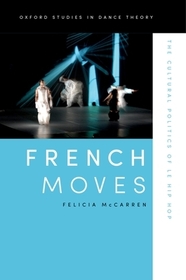
This book shows how le hip hop reflects a republic of culture rather than a culture industry; a minority identity politics that takes shape as a movement poetics or figural language; and the public valorization of dance as a technique, meriting unemployment compensation and understood as a high-tech knowledge practice.
MoreLong description:
For more than two decades, le hip hop has shown France's "other" face: danced by minorities associated with immigration and the suburbs, it has channeled rage against racism and unequal opportunity and offered a movement vocabulary for the expression of the multicultural difference that challenges the universalist discourse of the Republic.
French hip-hoppers subscribe to black U.S. culture to articulate their own difference but their mouv' developed differently, championed by a Socialist cultural policy as part of the patrimoine culturel, instituted as a pedagogy and supported as an art of the banlieue. In the multicultural mix of "Arabic" North African, African and Asian forms circulating with classical and contemporary dance performance in France, if hip hop is positioned as a civic discourse, and hip hop dancer as legitimate employment, it is because beyond this political recuperation, it is a figural language in which dancers express themselves differently, figure themselves as something or someone else.
French hip hop develops into concert dance not through the familiar model of a culture industry, but within a Republic of Culture; it nuances an "Anglo-Saxon" model of identity politics with a "francophone" post-colonial identity poetics and grants its dancers the statut civil of artists, technicians who develop and transmit body-based knowledge.
This book-- the first in English to introduce readers to the French mouv' --analyzes the choreographic development of hip hop into la danse urbaine, touring on national and international stages, as hip hoppeurs move beyond the banlieue, figuring new forms within the mobility brought by new media and global migration.
Felicia McCarren has succeeded brilliantly in taking dance out of its disciplinary confines, showing how vital a consideration of hip-hop is to any attempt to understand the dynamics of race and identity in contemporary France; the progress of the globalization of culture; the transformational power of moving bodes; and the mutually constitutive relation between bodies and technologies. McCarren makes it impossible for semiotics or cultural theory to remain indifferent to dance.
Table of Contents:
Contents
Introduction: "French?": Circulation, Immigration and Assimilation
Part I: Politics and poetics
Chapter 1: Hop Hop Citizens: politics, culture and performance
Chapter 2: Hip Hop Dance "speaks" French: droit de citer
Chapter 3: Hip Hop as post-colonial representation: Farid Berki's Invisible Armada and Exodust
Part II: Technology and techniques
Chapter 4: Dancing In and Out of the Box: Frank II Louise's Drop It!(2000) and Compagnie Choream's Epsilon (1999)
Chapter 5: Breaking history: Helène Cixous' L'histoire terrible mais inachevée de Norodom Sihanouk, Roi du Cambodge and Yiphun Chiem's Apsara (2007)
Chapter 6: Techniques: French urban dance in intellectual context
Conclusion

