

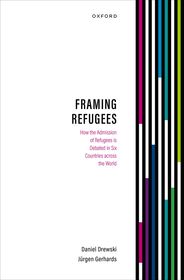
Framing Refugees
How the Admission of Refugees is Debated in Six Countries across the World
- Publisher's listprice GBP 95.00
-
42 892 Ft (40 850 Ft + 5% VAT)
The price is estimated because at the time of ordering we do not know what conversion rates will apply to HUF / product currency when the book arrives. In case HUF is weaker, the price increases slightly, in case HUF is stronger, the price goes lower slightly.
- Discount 10% (cc. 4 289 Ft off)
- Discounted price 38 603 Ft (36 765 Ft + 5% VAT)
Subcribe now and take benefit of a favourable price.
Subscribe
42 892 Ft

Availability
Estimated delivery time: In stock at the publisher, but not at Prospero's office. Delivery time approx. 3-5 weeks.
Not in stock at Prospero.
Why don't you give exact delivery time?
Delivery time is estimated on our previous experiences. We give estimations only, because we order from outside Hungary, and the delivery time mainly depends on how quickly the publisher supplies the book. Faster or slower deliveries both happen, but we do our best to supply as quickly as possible.
Product details:
- Publisher OUP Oxford
- Date of Publication 6 August 2024
- ISBN 9780198904724
- Binding Hardback
- No. of pages316 pages
- Size 240x162x23 mm
- Weight 640 g
- Language English 501
Categories
Short description:
This book explores the responses to admitting refugees adopted by governments in six different countries. It shows that government policy - as well as the stance of opposition parties - is dependent on the framing of both the country's collective identity and the identity and characteristics of the refugees.
MoreLong description:
This is an open access title available under the terms of a CC BY-NC-ND 4.0 International licence. It is free to read at Oxford Academic and offered as a free PDF download from OUP and selected open access locations.
Across the world, the number of people forcibly displaced from their homes has more than doubled during the last decade. Although international law does not allow states to turn back refugees, some countries close their borders to refugees, some open their borders and grant extensive protection, while others admit some groups of refugees while excluding others. How can we make sense of these different responses to admitting refugees? In this book, Daniel Drewski and Jürgen Gerhards show that governments' refugee policy, as well as the stance adopted by opposition parties on the issue, is heavily dependent on how they frame their country's collective identity on the one hand and the identity and characteristics of the refugees on the other. By defining the "we" and the "others", politicians draw on collectively shared cultural repertoires, which vary by country and by political constituency within a country. The book is based on a discourse analysis of parliamentary debates. It explores the specific framing of nations' identities and the corresponding perceptions of otherness by focusing on six countries that have been confronted with large numbers of refugees: Germany, Poland, and Turkey, all responding to the exodus of Syrian and Middle Eastern refugees; Chile's reaction to the Venezuelan displacement; Singapore and its stance towards Rohingya refugees; and Uganda's response to the displacement from South Sudan. The study explores not only differences between governments of different countries but also the conflicting views of different political parties within the same country.
This volume has emerged from research carried out as part of the Cluster of Excellence "Contestations of the Liberal Script - SCRIPTS", which analyzes the contemporary controversies about liberal ideas, institutions, and practices on the national and international level from a historical, global, and comparative perspective. It connects academic expertise in the social sciences and area studies and collaborates with research institutions in all world regions. Operating since 2019 and funded by the German Research Foundation (DFG), SCRIPTS unites eight major Berlin-based research institutions: Freie Universität Berlin, the Humboldt-Universität zu Berlin, the Berlin Social Science Center (WZB), the Hertie School, the German Institute for Economic Research (DIW), the Berlin branch of the German Institute of Global and Area Studies (GIGA), the Centre for East European and International Studies (ZOiS), and the Leibniz-Zentrum Moderner Orient (ZMO).
In this strikingly original comparative study, the authors analyze how countries as diverse as Chile, Germany, Poland, Singapore, Turkey, and Uganda embrace or reject refugees. They focus on how politicians fit refugees in their countries' story and national cultural repertoires, using frames pertaining to security, as well as legal, moral, cultural and other concerns. They adroitly marry the older political sociology tradition focused on social cleavages and the newer cultural sociology literature on symbolic boundaries to show how the often-used cosmopolitan vs communitarian dichotomy cannot account for patterns. Framing Refugees is a brilliant and refreshing contribution that will leave its mark on how social scientists think about crucial issues facing our societies.
Table of Contents:
Part I. Introduction
Setting the stage
Conceptual framework
The design of the study
Part II. Responding to the exodus of Syrian refugees
Open doors for 'brothers and sisters' in faith: Turkey's refugee policy towards Syrians
A humanitarian role model: Germany's initial open door policy and restrictive turn towards Syrian refugees
Defending national sovereignty and cultural homogeneity: Poland's policy of closed doors towards Syrian refugees
Part III. Responding to refugee crises in other world regions
Pan-African solidarity and international reputation: Uganda's policy of open doors towards refugees
Between and anti-Socialist foreign policy and the historical memory of dictatorship: Chile's ambivalent policy towards displaced Venezuelans
An economic perspective on immigration: Singapore's closed doors for refugees and open doors for immigrants with human capital
Part IV. Conclusion
The liberal script on refugee admission and the significance of national cultural repertoires
References
Index

