

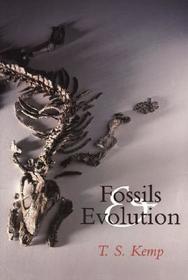
Fossils and Evolution
- Publisher's listprice GBP 75.99
-
34 309 Ft (32 675 Ft + 5% VAT)
The price is estimated because at the time of ordering we do not know what conversion rates will apply to HUF / product currency when the book arrives. In case HUF is weaker, the price increases slightly, in case HUF is stronger, the price goes lower slightly.
- Discount 10% (cc. 3 431 Ft off)
- Discounted price 30 878 Ft (29 408 Ft + 5% VAT)
Subcribe now and take benefit of a favourable price.
Subscribe
34 309 Ft

Availability
printed on demand
Why don't you give exact delivery time?
Delivery time is estimated on our previous experiences. We give estimations only, because we order from outside Hungary, and the delivery time mainly depends on how quickly the publisher supplies the book. Faster or slower deliveries both happen, but we do our best to supply as quickly as possible.
Product details:
- Publisher OUP Oxford
- Date of Publication 14 January 1999
- ISBN 9780198504245
- Binding Paperback
- No. of pages290 pages
- Size 234x157x18 mm
- Weight 453 g
- Language English
- Illustrations 1 halftone, numerous line figures 0
Categories
Short description:
The book interprets evidence from biology and from geology in order to describe and interpret how fossils are used in understanding biological evolution. It reviews the main ideas and research areas in contemporary palaeobiology.
MoreLong description:
The book is about the ideas, methodology and scope of contemporary palaeobiology, rather than a comprehensive, detailed survey of the factual basis of the subject. It addresses the issue of how on the one hand evolutionary theory is necessary for interpretation of the fossil record, and yet on the other the fossils themselves can contribute to evolutionary theory. This is shown not to be the circular argument between pattern and process sometimes alleged, but a matter of understanding carefully the interrelationship between palaeontological and neontological evidence.
The book is organised into two sections. Part 1 consists of four chapters outlining the principles, namely: the nature of the pattern/process relationship, taxonomic methods and the analysis of pattern, evolutionary theory and the analysis of process and the nature of incompleteness of the fossil record and what to do about it. Armed with these principles and methods, Part 2 is devoted to the five central areas of contemporary research in evolutionary palaeobiology. These are: fossils and phylogenetic inference; the mechanism of speciation; taxonomic turnover on the geological time-scale; mass-extinctions; the origin of new higher taxa. In each case the nature of the questions and the relevant kinds of evidence, including such new sources as molecular sequence data and stable isotope ratios where appropriate, are reviewed. The extent to which palaeobiology has, and has not yet, contributed to providing the sought after answers is made clear.
This extended essay is expansive, well researched and broad in scope. More importantly, it is intelligently written and assumes a certian familiarity with the ideas on board ... Readers of TREE should welcome it in to their personal and institutional libraries.
Table of Contents:
Introduction
Some fundamental ideas
Evolutionary theory: analysing process
Taxonomy: analysing pattern
Incompleteness and what to do about it
Fossils and phylogeny: if only we had more fossils
Speciation: gradual, punctuated, or what?
Rules and laws of taxonomic turnover: are there any?
Mass extinctions: resetting the evolutionary clock
The origin of new higher taxa: the ultimate question
Epilogue: where next?

