

- Publisher's listprice GBP 19.99
-
9 025 Ft (8 595 Ft + 5% VAT)
The price is estimated because at the time of ordering we do not know what conversion rates will apply to HUF / product currency when the book arrives. In case HUF is weaker, the price increases slightly, in case HUF is stronger, the price goes lower slightly.
- Discount 20% (cc. 1 805 Ft off)
- Discounted price 7 220 Ft (6 876 Ft + 5% VAT)
- Discount is valid until: 30 June 2026
Subcribe now and take benefit of a favourable price.
Subscribe
9 025 Ft

Availability
Estimated delivery time: In stock at the publisher, but not at Prospero's office. Delivery time approx. 3-5 weeks.
Not in stock at Prospero.
Why don't you give exact delivery time?
Delivery time is estimated on our previous experiences. We give estimations only, because we order from outside Hungary, and the delivery time mainly depends on how quickly the publisher supplies the book. Faster or slower deliveries both happen, but we do our best to supply as quickly as possible.
Product details:
- Publisher OUP USA
- Date of Publication 24 December 2024
- ISBN 9780197780435
- Binding Hardback
- No. of pages248 pages
- Size 201x137x25 mm
- Weight 363 g
- Language English 565
Categories
Short description:
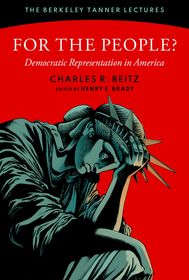
Many observers of American politics believe that representative government, particularly in the Congress, is failing. This book examines the case for failure: what are the outward signs, and how do they reflect breaches of underlying norms of fair and effective representation? The book argues that good representation demands healthy competition between parties, but that in today's America, that competition has run off the rails.
MoreLong description:
Many scholars of American government believe representative democracy is failing more systematically than even the recent spectacle of political extremism suggests. Unprecedented levels of elite polarization, severe partisan gerrymandering, weakened party institutions, easing of restrictions on campaign finance, and other forces-all in the context of rising levels of economic inequality-produce dysfunction that subverts healthy political competition. A gridlocked U.S. Congress offers few solutions to broadly recognized public problems. Legislation favors the interests of elites when they conflict with those of the majority.
In his 2022 Berkeley Tanner Lectures, Charles Beitz examines the narrative of dysfunction by reading the literature of political science as democratic theory. The narrative raises two questions. First, are symptoms documented by political scientists really failures? What norms of democratic representation do they infringe? This is a problem of diagnosis. Second, what would successful democratic representation look like? This is a problem of prescription. Beitz's book explores both.
The literatures of political scientists, constitutional lawyers, and democratic theorists on norms of democratic representation tend to cross too seldom. They do not agree about the meaning of fair and effective representation. One might look to democratic theory for insight, but for the most part it has been too remote from political practice to illuminate the problems of America's recent institutional history. Beitz's lectures bring the theory of democratic representation into closer contact with its troubled American practice. Emphasizing the constructive role that competition can play in democratic politics, they aim to articulate systemic norms for fair and effective democratic representation through critical engagement with the findings of scholars who have studied it in the wild.
The volume includes commentaries by a political scientist, Martin Gilens; a constitutional lawyer, Pamela S. Karlan; and a political theorist, Jane Mansbridge. Their commentaries elaborate themes in the lectures and pose critical questions. Charles Beitz responds in a concluding comment.
Table of Contents:
Acknowledgments
List of Contributors
Introduction - Henry E. Brady
FOR THE PEOPLE? DEMOCRATIC REPRESENTATION IN AMERICA
Preface and OverviewLecture I: Intimations of Failure - Charles R. Beitz
Lecture II: Regulating Rivalry - Charles R. Beitz
COMMENTARIES
The Preference-Policy Link and Representation - Martin Gilens
Systems, Dyads, and a Contingency Theory of Competition: A Citizen's View - Jane Mansbridge
Unrepresentative Democracy in America - Pamela S. Karlen
RESPONSE
Reply to Commentators: Preferences and Policy, Legitimacy, and Countermajoritarianism - Charles R. Beitz
References
Index

