

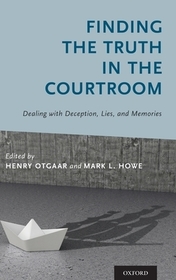
Finding the Truth in the Courtroom
Dealing with Deception, Lies, and Memories
- Publisher's listprice GBP 64.00
-
28 896 Ft (27 520 Ft + 5% VAT)
The price is estimated because at the time of ordering we do not know what conversion rates will apply to HUF / product currency when the book arrives. In case HUF is weaker, the price increases slightly, in case HUF is stronger, the price goes lower slightly.
- Discount 10% (cc. 2 890 Ft off)
- Discounted price 26 006 Ft (24 768 Ft + 5% VAT)
Subcribe now and take benefit of a favourable price.
Subscribe
28 896 Ft

Availability
printed on demand
Why don't you give exact delivery time?
Delivery time is estimated on our previous experiences. We give estimations only, because we order from outside Hungary, and the delivery time mainly depends on how quickly the publisher supplies the book. Faster or slower deliveries both happen, but we do our best to supply as quickly as possible.
Product details:
- Publisher OUP USA
- Date of Publication 16 November 2017
- ISBN 9780190612016
- Binding Hardback
- No. of pages296 pages
- Size 239x155x20 mm
- Weight 567 g
- Language English 0
Categories
Short description:
Finding the Truth in the Courtroom combines the science behind deception and memory and their relation in court. Testimonies are oftentimes the most important piece of evidence in legal cases. Hence, this book shows how such testimonies can be riddled with deception and/or memory errors, how to detect them, and what you can against them.
MoreLong description:
In many criminal trials, forensic technical evidence is lacking and triers of fact must rely on the reliability of eyewitness statements, identifications, and testimony; however, such reports can be riddled with deceptive statements or erroneous recollections. Based on such considerations, the question arises as to how one should weigh such eyewitness accounts given the theoretical and empirical knowledge in this field. Finding the Truth in the Courtroom focuses on how legal professionals, legal/forensic psychologists, and memory researchers can decide when statements or identifications are based on truthful or fabricated experiences and whether one can distinguish between lies, deception, and false memories.
The contributors, key experts in the field, assemble recent experimental work and case studies in which deception or false memory plays a dominant role. Topics discussed relate to the susceptibility to suggestive pressure (e.g., "Under which circumstances are children or adults the most vulnerable to suggestion?"), the fabrication of symptoms (e.g., "How to detect whether PTSD symptoms are malingered?"), and the detection of deceit (e.g., "Which paradigms are promising in deception detection?"), among others. By using this approach, this volume unites diverse streams of research (i.e., deception, malingering, false memory) that are involved in the reliability of eyewitness statements.
This book contains chapters by leading international experts on crucial topics in applying psychology to legal cases that hinge on psychological issues. Witnesses who are lying, reporting false information from memory, or feigning illness or forgetfulness can all compromise the search for truth in a case. The authors discuss the latest research on these topics and others. Lawyers and judges, as well as forensic psychologists, will find this book of great interest.
Table of Contents:
About the Editors
Contributors
Chapter 1: Deception and Memory in the Courtroom: An Overview
Henry Otgaar and Mark L. Howe
Part I: Memory in the Courtroom
Chapter 2: Misinformation in the Courtroom
Shari R. Berkowitz and Elizabeth F. Loftus
Chapter 3: Suggestibility in the Courtroom: How Memory Can Be Distorted During the Investigative and Legal Process
Fiona Gabbert and Lorraine Hope
Chapter 4: When Spontaneous Statements Should Not Be Trusted: False Memories in Children and Adults
Henry Otgaar and Mark L. Howe
Chapter 5: A Neurobiological Account False Memories
Vincent van de Ven, Henry Otgaar, and Mark L. Howe
Part II: Children in the Courtroom
Chapter 6: Assessing the Veracity of Children's Forensic Interviews: Implications for the Courtroom
Hayden M. Henderson and Samantha J. Andrews
Chapter 7: Putting Children's Memory and Suggestibility in their Place: An Analysis Considering Person, Topic, and Context
Deborah Goldfarb, Gail S. Goodman, Rakel P. Larson, Alejandra Gonzalez, and Mitchell L. Eisen
Part III: Deception in the Courtroom
Chapter 8: Nonverbal Detection of Deception
Aldert Vrij
Chapter 9: Building a Case: The Role of Empirically Based Interviewing Techniques in Case Construction
Timothy J. Luke, Maria Hartwig, Laure Brimbal, and Pär Anders Granhag
Chapter 10: Deception Detection Using Psychophysiological and Neural Measures
Ewout H. Meijer and Bruno Verschuere
Part IV: Malingering in the Courtroom
Chapter 11: Seven Myths About Feigning
Marko Jelicic, Harald Merckelbach, and Irena Boskovi
Chapter 12: False Symptom Claims and Symptom Validity Assessment
Thomas Merten
Index

