

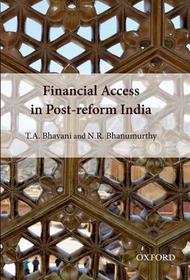
Financial Access in Post-Reform India
- Publisher's listprice GBP 25.00
-
11 287 Ft (10 750 Ft + 5% VAT)
The price is estimated because at the time of ordering we do not know what conversion rates will apply to HUF / product currency when the book arrives. In case HUF is weaker, the price increases slightly, in case HUF is stronger, the price goes lower slightly.
- Discount 10% (cc. 1 129 Ft off)
- Discounted price 10 159 Ft (9 675 Ft + 5% VAT)
Subcribe now and take benefit of a favourable price.
Subscribe
11 287 Ft

Availability
Only to order.
Why don't you give exact delivery time?
Delivery time is estimated on our previous experiences. We give estimations only, because we order from outside Hungary, and the delivery time mainly depends on how quickly the publisher supplies the book. Faster or slower deliveries both happen, but we do our best to supply as quickly as possible.
Product details:
- Publisher OUP India
- Date of Publication 26 January 2012
- ISBN 9780198076650
- Binding Hardback
- No. of pages224 pages
- Size 222x149x18 mm
- Weight 380 g
- Language English 0
Categories
Short description:
Using a macroeconomic growth approach, this book focuses on two important aspects of the Indian financial sector-development and access. It empirically analyses the structure, size, reach, and efficiency of the sector in the post-reform period and assesses availability of resources from the formal financial system to the productive sectors of the economy.
MoreLong description:
This book focuses on two important aspects of the financial sector-development and access. Combining theory with analytical rigour, the authors examine the level of and changes in financial development and access in the post-reform period.
Using a macroeconomic growth approach, financial development is looked at in terms of the structure of the financial system, its size, reach, and efficiency, and soundness of the banking sector. Financial access is conceptualized as the supply of financial resources for productive investment purposes. It is measured in terms of availability of finances from the formal financial system and its adequacy in taking care of productive investment needs. Based on empirical assessment of disaggregate data at the sectoral level, the authors suggest innovative solutions to reduce risk and transaction costs in order to improve financial access in the economy. They also compare specific aspects of the Indian financial system with that of the United Kingdom, Brazil, and China.
Table of Contents:
List of Tables and Figures
Preface; Acknowledgements
Introduction
Financial Development, Financial Access, and its Relation with Economic Growth
Analytical Considerations
Financial Development: Empirical Evidence
Financial Access: Household Level Evidence
Financial Access: Sector and Segment Level Evidence
Indian Financial Sector: An International Comparison
Private Participation in the Banking Sector
Summary, Findings, and Policy Recommendations
Bibliography
Index

