

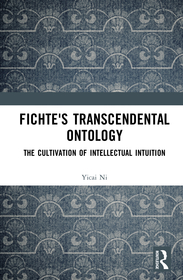
Fichte's Transcendental Ontology
The Cultivation of Intellectual Intuition
-
GET 10% OFF
- Publisher's listprice GBP 171.99
-
77 653 Ft (73 955 Ft + 5% VAT)
The price is estimated because at the time of ordering we do not know what conversion rates will apply to HUF / product currency when the book arrives. In case HUF is weaker, the price increases slightly, in case HUF is stronger, the price goes lower slightly.
- Discount 10% (cc. 1 Ft off)
- Discounted price 69 887 Ft (66 560 Ft + 5% VAT)
69 887 Ft

Availability
Estimated delivery time: In stock at the publisher, but not at Prospero's office. Delivery time approx. 3-5 weeks.
Not in stock at Prospero.
Why don't you give exact delivery time?
Delivery time is estimated on our previous experiences. We give estimations only, because we order from outside Hungary, and the delivery time mainly depends on how quickly the publisher supplies the book. Faster or slower deliveries both happen, but we do our best to supply as quickly as possible.
Product details:
- Edition number 1
- Publisher Routledge
- Date of Publication 26 June 2026
- ISBN 9781041141242
- Binding Hardback
- No. of pages148 pages
- Size 234x156 mm
- Weight 420 g
- Language English 699
Categories
Short description:
This book reinterprets Fichte’s thought as a “transcendental ontology,” arguing that his later Jena Wissenschaftslehre transcends the “History of Self-Consciousness” to establish a “History of Being”, where the I’s genesis aligns with the world’s historical development.
MoreLong description:
This book reinterprets Fichte’s thought as a “transcendental ontology,” arguing that his later Jena Wissenschaftslehre transcends the “History of Self-Consciousness” to establish a “History of Being,” where the I’s genesis aligns with the world’s historical development.
Challenging the dominant interpretive traditions established by Henrich and the Heidelberg School, this book adopts the framework of “Transcendental Ontology” to explicate the pre-conscious, self-generating activity of primordial reality. The narrative traces the roots of the ontological genesis from Kant’s doctrine of self-affection and Reinhold’s theory of representation, through Fichte’s theoretical confrontations with Schelling and Hölderlin, to its profound reception in the early 20th century. By examining the works of Neo-Kantians (Lask and Hirsch), Neo-Marxist Georg Lukács, and Russian philosopher Ivan Ilyin, this book demonstrates how Fichte’s philosophy evolved into a response to the spiritual crisis of European modernity. Its aim was to unite individuality with historical totality in a “concrete universal.”
This book is essential for scholars and advanced students of German Idealism, modern European philosophy, and intellectual history, especially those interested in subjectivity, the shift from Kant to Fichte and Schelling, and transcendental philosophy's impact on 20th-century thought.
“Ni Yicai has taken a topic that has been extensively covered and found something new to say about it. Taking Fichte’s early Wissenschaftslehre as constituting in fact a “transcendental ontology” of the thinking, acting “I”, he then traces the reception of this not as ending with Schelling and Hegel but as extending through the nineteenth and twentieth century, even deeply into Russian philosophy. He gives us a new way of seeing Fichte’s philosophy and its historical impact.”
Terry Pinkard, Georgetown University, USA
“The book by Ni Yicai, entitled Transcendental Philosophy as Transcendental Ontology, from the Genesis of the Transcendental I to the History of Being, offers an original and persuasive investigation aimed at demonstrating the contemporary relevance of transcendental philosophy. Starting from an innovative reading of Fichte and his concept of “intellectual intuition,” the volume engages with figures of twentieth-century Neo-Kantianism (Lask, Lukács, and Hirsch) as well as important representatives of 20th Century Russian philosophy (Ivan Ilyin), showing how transcendental philosophy constitutes an “ontology of subjectivity” that makes it possible to develop a philosophy of history in a contemporary key.”
Gaetano Rametta, University of Padova, Italy
MoreTable of Contents:
1 Kant and Reinhold’s Doctrine of Self-Affection and Its Transcendental-Ontological Implications 2 From Free Play to Self-feeling 3 Fichte and Schelling in Parallel 4 Absolute Being as Distanceless Unity of Subject-Object 5 Annihilation and Genesis of Being 6 The Genesis of the Philosophy of History 7 “A Lone Swan’s Solitary Flight Across the Void”
More
