

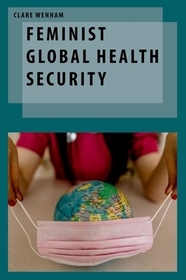
Feminist Global Health Security
Series: Oxford Studies in Gender and International Relations;
- Publisher's listprice GBP 78.00
-
35 217 Ft (33 540 Ft + 5% VAT)
The price is estimated because at the time of ordering we do not know what conversion rates will apply to HUF / product currency when the book arrives. In case HUF is weaker, the price increases slightly, in case HUF is stronger, the price goes lower slightly.
- Discount 10% (cc. 3 522 Ft off)
- Discounted price 31 695 Ft (30 186 Ft + 5% VAT)
Subcribe now and take benefit of a favourable price.
Subscribe
35 217 Ft

Availability
Reprint in consideration
Why don't you give exact delivery time?
Delivery time is estimated on our previous experiences. We give estimations only, because we order from outside Hungary, and the delivery time mainly depends on how quickly the publisher supplies the book. Faster or slower deliveries both happen, but we do our best to supply as quickly as possible.
Product details:
- Publisher OUP USA
- Date of Publication 30 September 2021
- ISBN 9780197556931
- Binding Hardback
- No. of pages296 pages
- Size 155x236x25 mm
- Weight 590 g
- Language English 0
Categories
Short description:
Global health security, focused on short-term response efforts, fails to consider the differential impacts of outbreaks on women. Feminist Global Health Security highlights the ways in which women are disadvantaged by global health security policy, through engagement with feminist international relations concepts of visibility, social and stratified reproduction, intersectionality, and structural violence. Wenham ultimately asks, what would global health policy look like if it were to take gender seriously, and how would this impact global disease control?
MoreLong description:
When Zika made headlines in 2016, images of women cradling babies affected with microcephaly spread across the media and pulled on heartstrings. But, as this book argues, whilst this outbreak was about women and babies, this outbreak also highlighted the lack of gendered considerations in global health security. The policy response to Zika focused on limiting the spread of the virus through domestic and civic cleaning to remove mosquitoes and by asking women to defer pregnancy. Both of these actions are inherently gendered, placing the burden of responsibility for stemming the spread of disease on women.
By taking Zika as its primary case but also touching on COVID-19, Feminist Global Health Security asks what the policy response to disease outbreaks tell us about the role of women in global health security. More broadly, what would global health policy look like if it were to take gender seriously, and how would this impact global disease control? Beyond raising questions of gender equity, Clare Wenham also considers global health security's lack of consideration for sustainability in epidemic preparedness and response. Wenham argues that global health security in general has thus far lacked a substantive feminist engagement, with the result that the very policies created to manage an outbreak of disease disproportionately fail to protect women. We know that women have biological pre-disposition and social vulnerability to contracting a number of infectious diseases, making them more susceptible to infection. Yet, the dominant gender-blind policy narrative of global health security has created pathways which focus on protecting the international spread of disease and state economies, rather than protecting those who are most likely to be affected. As such, the state-based structure of global health security provides the fault line for global health security's failure to engage women.
This book highlights the ways in which women are disadvantaged by global health security policy, through engagement with feminist international relations concepts of visibility, social and stratified reproduction, intersectionality, and structural violence. Wenham argues that it was no coincidence that poor, Black women living in low-quality housing were the most affected by the Zika outbreak and will continue to be so amid all epidemics, until meaningful engagement with gender is incorporated into global health security. As many news reports have made clear during COVID, there has been a recent sea change in thinking about the secondary effects of infectious disease control policy on women. However, we have yet to see this reflected in global health policy.
Recommended. Upper-division undergraduates through faculty.
Table of Contents:
Acknowledgements
List of Acronyms
Chapter 1 : Introduction
Chapter 2: Theorizing Feminist Health Security
Chapter 3: The Zika Virus
Chapter 4: In/Visibility
Chapter 5: Reproduction and the State
Chapter 6: Violence and Everyday Crises
Chapter 7: Conclusion
Epilogue: COVID-19
Bibliography

