

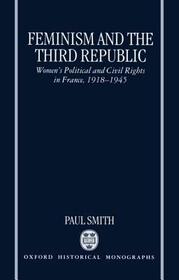
Feminism and the Third Republic
Women's Political and Civil Rights in France, 1918-1945
Series: Oxford Historical Monographs;
- Publisher's listprice GBP 152.50
-
68 853 Ft (65 575 Ft + 5% VAT)
The price is estimated because at the time of ordering we do not know what conversion rates will apply to HUF / product currency when the book arrives. In case HUF is weaker, the price increases slightly, in case HUF is stronger, the price goes lower slightly.
- Discount 10% (cc. 6 885 Ft off)
- Discounted price 61 968 Ft (59 018 Ft + 5% VAT)
Subcribe now and take benefit of a favourable price.
Subscribe
68 853 Ft

Availability
printed on demand
Why don't you give exact delivery time?
Delivery time is estimated on our previous experiences. We give estimations only, because we order from outside Hungary, and the delivery time mainly depends on how quickly the publisher supplies the book. Faster or slower deliveries both happen, but we do our best to supply as quickly as possible.
Product details:
- Publisher Clarendon Press
- Date of Publication 4 July 1996
- ISBN 9780198206231
- Binding Hardback
- No. of pages320 pages
- Size 224x143x23 mm
- Weight 491 g
- Language English
- Illustrations tables 0
Categories
Short description:
France is the home of the Declaration of the Rights of Man, yet women did not vote until 1945, many years later than their peers in other countries. In a country where civil rights had long been a rallying cry, women were not second-class citizens - they were not citizens at all. In this fascinating and ground-breaking study, Paul Smith assesses why Frenchwomen were repeatedly refused the rights of citizenship and examines the political relationships established by French feminists in order to achieve their goal: one woman, one vote.
MoreLong description:
Why did women in France not win the right to vote until 1945, three-quarters of a century after universal male suffrage had been established? The 1789 Déclaration des Droits de l'Homme et du Citoyen had aspired to provide the French people with lasting guarantees of their political and civil rights, whilst the constitutional laws of the Third Republic, established in the 1870s, consolidated a regime based on universal suffrage. For the unenfranchised women of France, however, civil rights had barely advanced since the Napoleonic code in 1904. Frenchwomen were not second-class citizens - they were not citizens at all, although this did not prevent Republicans from demanding sacrifices from women. In this fascinating and ground-breaking study, Paul Smith assesses why Frenchwomen were repeatedly refused the rights of citizenship, while their sisters elsewhere were gradually beginning to enjoy those rights. He examines how feminists in France set about staking a claim for the rights of all women to the vote, to their property, and to their bodies, and how they responded to republican and Catholic discourses on gender roles in the 1920s and 1930s. Finally, he analyses the political relationships established by French feminists in order to achieve their goal.
The strength of Smith's book lies in the wealth of detail which he supplies concerning the relationships between women's groups and political parties ... He also makes a revealing study of the legislative history of the law of 1938 which gave married women full civil capacity ... when Smith engages in sustained analysis he does so to good effect.

