

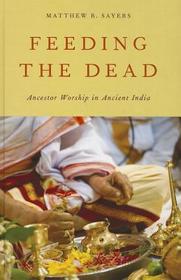
Feeding the Dead
Ancestor Worship in Ancient India
- Publisher's listprice GBP 145.00
-
65 467 Ft (62 350 Ft + 5% VAT)
The price is estimated because at the time of ordering we do not know what conversion rates will apply to HUF / product currency when the book arrives. In case HUF is weaker, the price increases slightly, in case HUF is stronger, the price goes lower slightly.
- Discount 10% (cc. 6 546 Ft off)
- Discounted price 58 921 Ft (56 115 Ft + 5% VAT)
Subcribe now and take benefit of a favourable price.
Subscribe
65 467 Ft

Availability
printed on demand
Why don't you give exact delivery time?
Delivery time is estimated on our previous experiences. We give estimations only, because we order from outside Hungary, and the delivery time mainly depends on how quickly the publisher supplies the book. Faster or slower deliveries both happen, but we do our best to supply as quickly as possible.
Product details:
- Publisher OUP USA
- Date of Publication 12 September 2013
- ISBN 9780199917471
- Binding Hardback
- No. of pages208 pages
- Size 160x236x17 mm
- Weight 456 g
- Language English
- Illustrations 3 illus. 0
Categories
Short description:
Feeding the Dead outlines the early history of ancestor worship in South Asia, from the earliest sources available, the Vedas, up to the descriptions found in the Dharmshastra tradition.
MoreLong description:
Feeding the Dead outlines the early history of ancestor worship in South Asia, from the earliest sources available, the Vedas, up to the descriptions found in the Dharmshastra tradition. Most prior works on ancestor worship have done little to address the question of how shraddha, the paradigmatic ritual of ancestor worship up to the present day, came to be. Matthew R. Sayers argues that the development of shraddha is central to understanding the shift from Vedic to Classical Hindu modes of religious behavior. Central to this transition is the discursive construction of the role of the religious expert in mediating between the divine and the human actor. Both Hindu and Buddhist traditions draw upon popular religious practices to construct a new tradition. Sayers argues that the definition of a religious expert that informs religiosity in the Common Era is grounded in the redefinition of ancestral rites in the Grhyasutras. Beyond making more clear the much misunderstood history of ancestor worship in India, this book addressing the serious question about how and why religion in India changed so radically in the last half of the first millennium BCE. The redefinition of the role of religious expert is hugely significant for understanding that change. This book ties together the oldest ritual texts with the customs of ancestor worship that underlie and inform medieval and contemporary practice.
This compact volume makes a notable contribution to our understanding of doctrinal and institutional shifts in India in the last centuries before the Common Era. Sayers is one of just a handful of recent scholars to call attention to the importance of the Vedic domestic ritual codes in the creation of what has come to be known as 'classical Hinduism.' He is to be congratulated for setting the complex ritual particulars within a clearly limned overview of the competing religious ideologies being 'marketed' by rival groups of professional 'religious experts.' He manages to do this without trivializing the ideas at stake, and without glibly reifying categories such as 'popular' and 'elite' or 'Brahmanical' and 'non-Brahmanical.'
Table of Contents:
List of Tables
Acknowledgements
Abbreviations
Introduction
Chapter 1: Ancestral Rites in the Early Vedas
Chapter 2: The Solemn Ancestral Rites
Chapter 3: The Domestic Rice-ball Sacrifice to the Ancestors
Chapter 4: The sraddha-rite
Chapter 5: Ancestral Rites in the Buddhist Literature
Chapter 6: Soteriology
Chapter 7: Mediation
Conclusion
Appendix
Notes
Glossary of Sanskrit Terms
Bibliography
Index

