

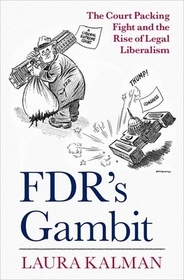
FDR's Gambit
The Court Packing Fight and the Rise of Legal Liberalism
- Publisher's listprice GBP 28.99
-
13 088 Ft (12 465 Ft + 5% VAT)
The price is estimated because at the time of ordering we do not know what conversion rates will apply to HUF / product currency when the book arrives. In case HUF is weaker, the price increases slightly, in case HUF is stronger, the price goes lower slightly.
- Discount 20% (cc. 2 618 Ft off)
- Discounted price 10 471 Ft (9 972 Ft + 5% VAT)
- Discount is valid until: 30 June 2026
Subcribe now and take benefit of a favourable price.
Subscribe
13 088 Ft

Availability
Estimated delivery time: In stock at the publisher, but not at Prospero's office. Delivery time approx. 3-5 weeks.
Not in stock at Prospero.
Why don't you give exact delivery time?
Delivery time is estimated on our previous experiences. We give estimations only, because we order from outside Hungary, and the delivery time mainly depends on how quickly the publisher supplies the book. Faster or slower deliveries both happen, but we do our best to supply as quickly as possible.
Product details:
- Publisher OUP USA
- Date of Publication 14 November 2022
- ISBN 9780197539293
- Binding Hardback
- No. of pages440 pages
- Size 164x237x35 mm
- Weight 726 g
- Language English
- Illustrations 67 political cartoons; 16 b/w halftones 254
Categories
Short description:
When Franklin Roosevelt proposed adding up to six new justices to the Supreme Court in 1937, a firestorm exploded. FDR was accused of "Court packing," dictatorial ambitions, political trickery, undermining the rule of law, and undercutting judicial independence. Drawing upon extensive archival research, Laura Kalman revises the conventional wisdom by telling the story as it unfolded in FDR's Gambit. She argues that acumen, not arrogance, accounted for Roosevelt's actions. Far from erring tragically, he came very close to getting additional justices, and the Court itself changed course.
MoreLong description:
A comprehensive, engaging, and revisionist account of the Court fight that ties it to contemporary policy debates.
In the last past few years, liberals concerned about the prospect of long-term conservative dominance of the federal courts have revived an idea that famously crashed and burned in the 1930s: court packing. Not surprisingly, today's court packing advocates have run into a wall of opposition, with most citing the 1930s episode as one FDR's greatest failures. In early 1937, Roosevelt-fresh off a landslide victory-stunned the country when he proposed a plan to expand the size of the court by up to six justices. Today, that scheme is generally seen as an act of hubris-an instance where FDR failed to read Congress and the public properly.
In FDR's Gambit, the eminent legal historian Laura Kalman challenges the conventional wisdom by telling the story as it unfolded, without the distortions of hindsight. Indeed, while scholars have portrayed the Court Bill as the ill-fated brainchild of a hubristic President made overbold by victory, Kalman argues to the contrary that acumen, not arrogance, accounted for Roosevelt's actions. Far from erring tragically from the beginning, FDR came very close to getting additional justices, and the Court itself changed course. As Kalman shows, the episode suggests that proposing a change in the Court might give the justices reason to consider whether their present course is endangering the institution and its vital role in a liberal democracy.
Based on extensive archival research, FDR's Gambit offers a novel perspective on the long-term effects of court packing's failure, as a legacy that remains with us today. Whether or not it is the right remedy for today's troubles, Kalman argues that court packing does not deserve to be recalled as one fated for failure in 1937.
This boldly revisionist history of FDR's effort to 'pack' the Supreme Court could not be more timely or relevant. Laura Kalman, one of the country's most important legal historians, offers a spellbinding exploration of the realm where law and politics met in 1937-and where, with the stakes as high as ever, they still meet today.
Table of Contents:
Acknowledgments
Preface Court Packing as History and Memory
1. Roosevelt v. "The Nine Old Men": March 1933-February 1936
2. Victory-and Its Fruits: April 6-December 26, 1936
3. Bright Prospects, Bold Opposition: January 1-March 3, 1937
4. A Change in Tune at the White House--and at the Court?: March 4-April 11, 1937
5. "Talk of Compromise...Heard Everywhere": April 12-May 25, 1937
6. "Prestige": May 18, 1937-November 8, 1938
7. Afterlife: 1937-2021
Afterword About those "later historians": Historians, Political Scientists, and Law Professors Confront "1937"
Notes
Index

