

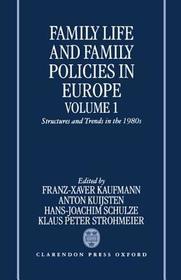
Family Life and Family Policies in Europe
Volume 1: Structures and Trends in the 1980s
- Publisher's listprice GBP 70.00
-
33 442 Ft (31 850 Ft + 5% VAT)
The price is estimated because at the time of ordering we do not know what conversion rates will apply to HUF / product currency when the book arrives. In case HUF is weaker, the price increases slightly, in case HUF is stronger, the price goes lower slightly.
- Discount 10% (cc. 3 344 Ft off)
- Discounted price 30 098 Ft (28 665 Ft + 5% VAT)
Subcribe now and take benefit of a favourable price.
Subscribe
33 442 Ft

Availability
printed on demand
Why don't you give exact delivery time?
Delivery time is estimated on our previous experiences. We give estimations only, because we order from outside Hungary, and the delivery time mainly depends on how quickly the publisher supplies the book. Faster or slower deliveries both happen, but we do our best to supply as quickly as possible.
Product details:
- Publisher Clarendon Press
- Date of Publication 19 February 1998
- ISBN 9780198233275
- Binding Hardback
- No. of pages446 pages
- Size 243x163x30 mm
- Weight 786 g
- Language English
- Illustrations line figures, numerous tables 0
Categories
Short description:
This book presents a standardized framework for the analysis of family development and family policies in Europe. It offers an accessible and coherent account of how harmonized--or not--the various countries are in terms of cultural and political attitudes towards the family, as well as institutions.
MoreLong description:
There is widespread evidence that the family has undergone profound social changes in the past decades. However, the interpretations of these changes remain diverse and inconsistent, particularly when it comes to international comparative research.
This reinterpretation of the empirical evidence has grown from the co-operation of researchers from ten European countries. It overcomes the limitations of international demographic statistics by using sample surveys and the available register data in order to study the interaction of political, economic, and demographic factors in the changing forms of private lives during the 1980s. The standardized framework connects the macro perspective of national policy peculiarities with the micro perspective of an analysis of the changing living arrangements of two cohorts of women--those starting families and those whose children are leaving home. Thus, the book provides new interdisciplinary insights into country-specific information and tools for specific thematic comparisons.
The evidence presented in this study reveals strong and persistent between-nation differences in the ways people adapt their lives, and the choices they have to make between work and family life, to changing circumstances. Confronted with national cultural and political attitudes, as well as differences in institutional designs concerning the family, these differences between nations in the priorities of various forms of family life are explained as the reactions of rational actors to various normative orientations and institutional opportunities.
Provides new country-specific information and tools for specific thematic comparisons and, by using a wide interdisciplinary approach, gives new insights into modern family structures. - Maria Teresa Lopez Lopez. International Social Security Review. April 1998.
Table of Contents:
Family Life and Family Policies in Europe: An Introduction
Denmark: The Land of the Vanishing Housewife
France: The Institutionalization of Plurality
The Federal Republic of Germany: Polarization of Family Structure
The Former German Democratic Republic: The Normed Family
Great Britain: The Lone Parent as the New Norm?
Ireland
Italy: Changing the Family from Within
The Netherlands: The Latent Family
Sweden: A Case Study of Solidarity and Equality
Switzerland: The Family Neglected by the State
Ten Countries in Europe: An Overview
Index

