

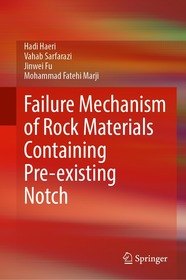
Failure Mechanism of Rock Materials Containing Pre-existing Notch
- Publisher's listprice EUR 181.89
-
71 046 Ft (67 663 Ft + 5% VAT)
The price is estimated because at the time of ordering we do not know what conversion rates will apply to HUF / product currency when the book arrives. In case HUF is weaker, the price increases slightly, in case HUF is stronger, the price goes lower slightly.
- Discount 20% (cc. 14 209 Ft off)
- Discounted price 56 837 Ft (54 130 Ft + 5% VAT)
- Discount is valid until: 30 June 2026
Subcribe now and take benefit of a favourable price.
Subscribe
62 521 Ft

Availability
Not yet published.
Why don't you give exact delivery time?
Delivery time is estimated on our previous experiences. We give estimations only, because we order from outside Hungary, and the delivery time mainly depends on how quickly the publisher supplies the book. Faster or slower deliveries both happen, but we do our best to supply as quickly as possible.
Product details:
- Publisher Springer Nature Singapore
- Date of Publication 14 June 2026
- ISBN 9789819585649
- Binding Hardback
- No. of pages302 pages
- Size 235x155 mm
- Language English
- Illustrations XII, 302 p. 300 illus., 294 illus. in color. 700
Categories
Long description:
This book explores the impact of notch geometry on the strength failure and crack evolution behavior of rock materials. It quantitatively compares simulated results from discrete element modeling with experimental findings related to the fracture mechanics of rock materials containing defects. Additionally, it establishes a relationship between the processes of crack evolution and the distribution of acoustic emissions in pre-fissured rock materials throughout the deformation process. The book discusses the mechanisms of crack evolution in pre-fissured rock materials under various confining pressures and analyzes how non-persistent joints affect the failure mechanisms of notched rock from a practical perspective.
MoreTable of Contents:
Summarizes the crack evolution behaviour of rocklike materials and real rocks from the experimental and numerical viewpoint.- Summarize a systematical analysis on fracture coalescence behaviour of rock like material containing two parallel fissures under uniaxial compression by the experimental and numerical simulation.- Deals with an investigation on the failure mechanical behaviour of rock mass containing two unparallel fissures under confining pressure using experimental test and PFC simulation.- Summarise a systematical analysis on fracture coalescence behaviour of rock like material containing three unparallel fissures under uniaxial compression by the experimental and numerical simulation.- Summarizes the influence of non-persistent joint sets on the failure behaviour of rock like material under uniaxial compression test.- Describe the effects of interaction between multiple small holes and a single notch on the mechanical behavior of artificial gypsum specimens using experimental test and numerical simulation.- Describe the effect of rock bridge continuity and area on shear behavior of sliding surface.- Deal with the failure mechanism of echelon non-persistent open joints under shear loading using experimental test and PFC2D simulation.- Describe the physical test and PFC modelling of notched rock pillar failure.- Discussed the influence of non-persistent notch on the rock fragmentation mechanism underneath the U shape TBM cutters using experimental tests and numerical simulations with PFC2D.- Describe the interaction between rock bolt and rock bridge under both of the axial tensile loading and direct shear loading.
More
