

- Publisher's listprice GBP 93.00
-
41 989 Ft (39 990 Ft + 5% VAT)
The price is estimated because at the time of ordering we do not know what conversion rates will apply to HUF / product currency when the book arrives. In case HUF is weaker, the price increases slightly, in case HUF is stronger, the price goes lower slightly.
- Discount 10% (cc. 4 198 Ft off)
- Discounted price 37 791 Ft (35 991 Ft + 5% VAT)
Subcribe now and take benefit of a favourable price.
Subscribe
41 989 Ft

Availability
printed on demand
Why don't you give exact delivery time?
Delivery time is estimated on our previous experiences. We give estimations only, because we order from outside Hungary, and the delivery time mainly depends on how quickly the publisher supplies the book. Faster or slower deliveries both happen, but we do our best to supply as quickly as possible.
Product details:
- Publisher OUP USA
- Date of Publication 13 July 2022
- ISBN 9780190913366
- Binding Hardback
- No. of pages240 pages
- Size 157x226x25 mm
- Weight 454 g
- Language English
- Illustrations 9 b&w illustrations 203
Categories
Short description:
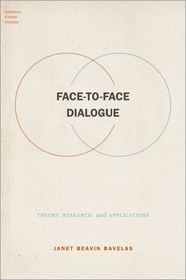
Janet Beavin Bavelas proposes that face-to-face dialogue is the primary site of language use, with unique features that make it the fastest, most precise, and most skillful activity that ordinary individuals do together. Writing for an inter-disciplinary readership, Bavelas draws on decades of experimental research combined with qualitative measures to illustrate the advantages of focusing on dialogue (rather than on individuals) and of using a multi-modal lens.
MoreLong description:
Face-to-face dialogue is our basic form of language use. It is, and always has been, the only form of language use that spans all cultures and societies. Face-to-Face Dialogue: Theory, Research, and Applications focuses on the unique combination of features that make face-to-face dialogue the fastest, most precise, and most skillful activity that ordinary individuals do together.
Writing for an inter-disciplinary readership, Bavelas draws on her research program of over three decades to reveal the unique features of face-to-face dialogue. Unlike written or mediated forms, face-to-face dialogue uses both speech and co-speech gestures and also permits rapid-even simultaneous-exchanges. This book demonstrates the importance of focusing on interactions rather than individuals and on specific multi-modal acts rather than all nonverbal communication. Bavelas's mixed research methods begin inductively, leading to experiments with qualitative measures. Second-by-second microanalysis uncovers details of how a dialogue works. By focusing on communication as joint action, Face-to-Face Dialogue refocuses the conversation around the science of human communication, with realizable practical applications for researchers and professionals alike.
Janet Bavelas is a true expert on face-to-face dialogue, and in this book she gives us a master class on the topic. She takes us beyond speaking and listening into the 'space between'-into the dialogue itself. She takes us beyond transcriptions of talk into the microscopic timing and meaning of speech and gestures-both inside and outside the lab. She helps us appreciate what it really takes to understand people speaking face-to-face."-Herbert H. Clark, Albert Ray Lang Professor of Psychology, Emeritus, Stanford University
Table of Contents:
Preface by the Series Editor
Preface by the Author
Acknowledgements
Chapter One: Appreciating Face-to-face Dialogue
PART I. CHANGING THE FOCUS
Chapter Two: From Individuals to Interactions
Chapter Three: From Nonverbal Communication to Co-speech Gesture
Chapter Four: Common Goals, Different Methods
PART II. INSIDE FACE-TO-FACE DIALOGUE
Chapter Five: Doing Dialogue
Chapter Six: Dialogue Favor Demonstrations
Chapter Seven: The Social Life of Hand Gestures
Chapter Eight: The Social Life of Facial Gestures
Chapter Nine: Meaning and Understanding as an Interactional Process
PART III. DIALOGUES IN APPLIED SETTINGS
Chapter Ten: Dialogues in Computer-Mediated Communication, Autism, and Medical Interactions
Chapter Eleven: Psychotherapy as Dialogue
Chapter Twelve: A Summary So Far
References
Index

