

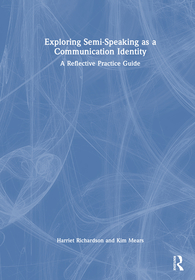
Exploring Semi-Speaking as a Communication Identity
A Reflective Practice Guide
- Publisher's listprice GBP 145.00
-
65 467 Ft (62 350 Ft + 5% VAT)
The price is estimated because at the time of ordering we do not know what conversion rates will apply to HUF / product currency when the book arrives. In case HUF is weaker, the price increases slightly, in case HUF is stronger, the price goes lower slightly.
- Discount 20% (cc. 13 093 Ft off)
- Discounted price 52 374 Ft (49 880 Ft + 5% VAT)
- Discount is valid until: 30 June 2026
Subcribe now and take benefit of a favourable price.
Subscribe
58 921 Ft

Availability
Not yet published.
Why don't you give exact delivery time?
Delivery time is estimated on our previous experiences. We give estimations only, because we order from outside Hungary, and the delivery time mainly depends on how quickly the publisher supplies the book. Faster or slower deliveries both happen, but we do our best to supply as quickly as possible.
Product details:
- Edition number 1
- Publisher Routledge
- Date of Publication 30 June 2026
- ISBN 9781032789569
- Binding Hardback
- No. of pages170 pages
- Size 297x210 mm
- Language English
- Illustrations 3 Illustrations, color; 3 Halftones, black & white; 3 Tables, black & white 700
Categories
Short description:
Exploring Semi-Speaking and Communication Identity is a reflective practice companion which takes an expansive approach to supporting autistic and otherwise neurodivergent people who do not always have access to speech.
MoreLong description:
Exploring Semi-Speaking as a Communication Identity is a reflective practice companion which takes an expansive approach to supporting autistic and otherwise neurodivergent people who do not always have access to speech.
Written for speech and language therapists, and relevant to other interested people, the book challenges traditional ideas about communication. It offers practical insights grounded in the neurodiversity paradigm, and amplifies neurodivergent voices alongside contributions from people with lived and professional experience of semi-speaking, situational mutism and AAC.
Readers are invited on a journey of reflection through their own practice, reconsidering assumptions, deepening thinking, and expanding their understanding in this area. Topics include communication identity, communication capacity, AAC, multi-modal communication and shared understanding to support collaborative discussion.
Encouraging curiosity, this comprehensive resource is essential reading for anyone interested in semi-speaking and communication identity.
'This is a pioneering book on semi speaking communication and identity. It gives an understanding of what semi-speaking identity is, guidance on how to explore this with others and support to develop perspective and practice. It has helped me as a clinician, but also as a leader, partner and parent’. - Dr Becky Quicke, Clinical Psychologist and Founder, Autistic Girls.
"This work is an invitation to unlearn what we think communication should be. Both authors have a genuine commitment to transforming their practice — to listening differently, to questioning power, to embracing the unfinished — making this book not just theory, but living practice." - Warda Farah, Founder Entangle Collective, Independent Researcher
MoreTable of Contents:
Dedication
Meet the contributors and author bios
Acknowledgements
Foreword
Introduction
Section 1
1. What is semi-speaking?
2. Understanding neurodiversity. A term, a paradigm and a social justice movement.
3. An insight into the semi-speaking experience
Section 2
Introduction to Section 2
4. Preparing to support discussions exploring semi-speaking
5. Communication identity and semi-speaking
6. Supporting communication capacity
7. AAC and multi-modal communication
8. Exploring semi-speaking with other people; family, friends and education
9. Exploring semi-speaking at work/ supporting colleagues
10. Exploring semi-speaking in a single session
Section 2 conclusion
Section 3: Resources
1. Information sheet on semi-speaking
2. Suggestions for supporting AAC information
3. Creating spaces to explore AAC and multi-modal communication
4. AAC myth busting
5. Ideas for supporting colleagues at work
6. Ideas for supporting semi-speaking students
7. Tips for writing about semi-speaking
8. Frequently asked questions
9. Communication cards
References / bibliography
Index
More

