

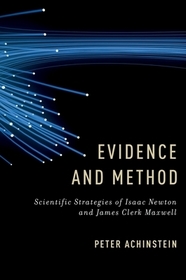
Evidence and Method
Scientific Strategies of Isaac Newton and James Clerk Maxwell
- Publisher's listprice GBP 41.99
-
18 958 Ft (18 055 Ft + 5% VAT)
The price is estimated because at the time of ordering we do not know what conversion rates will apply to HUF / product currency when the book arrives. In case HUF is weaker, the price increases slightly, in case HUF is stronger, the price goes lower slightly.
- Discount 10% (cc. 1 896 Ft off)
- Discounted price 17 062 Ft (16 250 Ft + 5% VAT)
Subcribe now and take benefit of a favourable price.
Subscribe
18 958 Ft

Availability
printed on demand
Why don't you give exact delivery time?
Delivery time is estimated on our previous experiences. We give estimations only, because we order from outside Hungary, and the delivery time mainly depends on how quickly the publisher supplies the book. Faster or slower deliveries both happen, but we do our best to supply as quickly as possible.
Product details:
- Publisher OUP USA
- Date of Publication 11 April 2013
- ISBN 9780199921850
- Binding Hardback
- No. of pages192 pages
- Size 217x148x18 mm
- Weight 331 g
- Language English 0
Categories
Short description:
In this book, Peter Achinstein proposes and defends several objective concepts of evidence. He then explores the question of whether a scientific method, such as that represented in the four "Rules for the Study of Natural Philosophy" that Isaac Newton invoked in proving his law of gravity, can be employed in demonstrating how the proposed definitions of evidence are to be applied to real scientific cases.
MoreLong description:
What is meant by scientific evidence, and how can a definition of this concept be applied in the sciences to determine whether observed facts constitute evidence that a given theory is true?
In this book, Peter Achinstein proposes and defends several objective concepts of evidence. He then explores the question of whether a scientific method, such as that represented in the four "Rules for the Study of Natural Philosophy" that Isaac Newton invoked in proving his law of gravity, can be employed in demonstrating how the proposed definitions of evidence are to be applied to real scientific cases. In answering this question, he offers a new interpretation of Newton's controversial rules. Contrary to what many methodologists assume, whether the rules, so interpreted, can be used to determine whether observed phenomena provide evidence for a theory is an empirical question, not an a priori one. Finally, in order to deal with numerous cases in which evidence is insufficient to establish a theory, or where no theory is even available, Achinstein describes and defends three scientific methods proposed by the 19th century theoretical physicist James Clerk Maxwell, in the course of developing his electrical and molecular theories.
[T]he renowned philosopher of science Peter Achinstein focuses on the question whether observed phenomena constitute evidence that a theory is true. ...The book is clearly written, aims at a general audience and provides valuable insights into the works of these two icons of modern science. Thus, it is warmly recommended for the readers of Science & Education.
Table of Contents:
Preface
Chapter 1: A Problem about Evidence
Chapter 2: Newton's Rules
Chapter 3: Newtonian Extensions, a Rival, Justifying Induction, and Evidence
Chapter 4: What to Do If You Cannot Establish a Theory: Maxwell's Three Methods

