

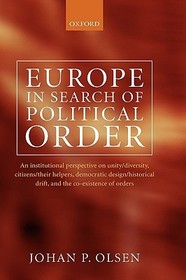
Europe in Search of Political Order
An Institutional Perspective on Unity/Diversity, Citizens/their Helpers, Democratic Design/Historical Drift, and the Co-Existence of Orders
- Publisher's listprice GBP 47.99
-
21 667 Ft (20 635 Ft + 5% VAT)
The price is estimated because at the time of ordering we do not know what conversion rates will apply to HUF / product currency when the book arrives. In case HUF is weaker, the price increases slightly, in case HUF is stronger, the price goes lower slightly.
- Discount 10% (cc. 2 167 Ft off)
- Discounted price 19 500 Ft (18 572 Ft + 5% VAT)
Subcribe now and take benefit of a favourable price.
Subscribe
21 667 Ft

Availability
printed on demand
Why don't you give exact delivery time?
Delivery time is estimated on our previous experiences. We give estimations only, because we order from outside Hungary, and the delivery time mainly depends on how quickly the publisher supplies the book. Faster or slower deliveries both happen, but we do our best to supply as quickly as possible.
Product details:
- Publisher OUP Oxford
- Date of Publication 1 February 2007
- ISBN 9780199214341
- Binding Hardback
- No. of pages352 pages
- Size 240x166x30 mm
- Weight 634 g
- Language English 0
Categories
Short description:
One of the world's most influential Political Scientists provides an innovative perspective on institutional change and reform in the EU.
MoreLong description:
This book deals with ongoing processes of European cooperation and integration, processes that may have a potential to change the political organization of Europe. Based on ideas from 'the new institutionalism' the book offers a systematic perspective on institutional change and in particular the role of institutions in relation to four central and durable issues in the study of political life. These are: (1) the mediation between unity and diversity: what ties a society together and what keeps it apart. (2) The relations between citizens and their helpers: why the democratic deficit in the European Union can not be eliminated solely by making mechanisms of direct citizens participation and representation more efficient. Needed are also institutions that make direct participation redundant because they routinely work with integrity, generating expected and desired outcomes. (3) The relation between democratic design and historical drift: To what degree democracies are able to design and reform key institutions of governance so that their structures reflect popular will, understanding and control. (4) The co-existence of old and new political orders: How elements of a new order may supplement rather than replace elements of the old order, generating a 'mixed order' based on partly inconsistent principles and rules.
MoreTable of Contents:
Introduction
Part I. Unity and diversity
The possibility of political order
The legacy: Nationalization of political life
"Europeanization": fashionable and contested term
A prelude to an institutional account
Part II. Citizens and their helpers
What role for Euro citizens?
"DEL to serve the citizens of Europe"
Institutions of governance - can democracies choose them?
Reformers as pawns, engineers and gardeners
Coping with conflict at constitutional moments
Part IV. New and old political orders
Europeanization of the territorial state
Towards a European administrative space?
Bibliography
Index

