

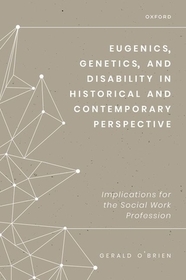
Eugenics, Genetics, and Disability in Historical and Contemporary Perspective
Implications for the Social Work Profession
- Publisher's listprice GBP 61.00
-
27 541 Ft (26 230 Ft + 5% VAT)
The price is estimated because at the time of ordering we do not know what conversion rates will apply to HUF / product currency when the book arrives. In case HUF is weaker, the price increases slightly, in case HUF is stronger, the price goes lower slightly.
- Discount 20% (cc. 5 508 Ft off)
- Discounted price 22 033 Ft (20 984 Ft + 5% VAT)
- Discount is valid until: 30 June 2026
Subcribe now and take benefit of a favourable price.
Subscribe
27 541 Ft

Availability
Estimated delivery time: In stock at the publisher, but not at Prospero's office. Delivery time approx. 3-5 weeks.
Not in stock at Prospero.
Why don't you give exact delivery time?
Delivery time is estimated on our previous experiences. We give estimations only, because we order from outside Hungary, and the delivery time mainly depends on how quickly the publisher supplies the book. Faster or slower deliveries both happen, but we do our best to supply as quickly as possible.
Product details:
- Publisher OUP USA
- Date of Publication 21 February 2023
- ISBN 9780197611234
- Binding Hardback
- No. of pages152 pages
- Size 243x162x17 mm
- Weight 358 g
- Language English 281
Categories
Short description:
In the U.S. the eugenic alarm grew in the first three decades of the twentieth century leading to sterilization, institutionalization and other laws to restrict procreation, especially among persons with certain disabilities. This period also marked the beginning of the social work profession; and many social workers struggled with coming to grips with eugenics as a possible means of improving society. These historical issues have evolved in many ways, but the continued inter-relationship between the social work profession and persons with disabilities has particular importance during an era marked by continued genetic innovations and controversies.
MoreLong description:
Eugenics, Genetics, and Disability in Historical and Contemporary Perspective focuses on the conceptual relationship between the American eugenic movement of the early 1900s and contemporary genetic research, policy and practices, and their relevance for social work and related professions. While the expansion of pre-natal testing and other genetic innovations are often couched as a form of "new eugenics," this description is only partially correct. This book provides the first in-depth exploration of the relationship between the emerging social work profession and the eugenic movement during the first quarter of the twentieth century and considers the historical importance of this for the profession today.
Social workers played a particularly important role in the movement of eugenic policies from targeting persons with disabilities to limiting procreation among "welfare" recipients, especially minority women. As the profession attempts to come to terms with this problematic history, it also needs to understand the dual "faces" it displays to persons with disabilities. Often purported as supporters of such persons, social workers' continued embracement of the medical model of disabilities keeps them from being accepted by many as true allies in the fight for social justice related to disability inclusion.
This book is geared toward those in the field of social work, it is accessible to general audiences and provides an excellent introduction to the subject for practitioners, policymakers, and the public alike.
Table of Contents:
Introduction
Chapter 1 Setting the Stage: A Tale of Two Policy Statements
Chapter 2 A Brief History of Eugenic Control
Chapter 3 Eugenics and Persons with Disabilities
Chapter 4 Eugenics and the Social Work Profession
Chapter 5 Social Work and Contemporary Bioethical Debates
Chapter 6 The Impact of the Social Model of Disability
Chapter 7 Implications and Ongoing Questions
References

