

- Publisher's listprice GBP 77.00
-
34 765 Ft (33 110 Ft + 5% VAT)
The price is estimated because at the time of ordering we do not know what conversion rates will apply to HUF / product currency when the book arrives. In case HUF is weaker, the price increases slightly, in case HUF is stronger, the price goes lower slightly.
- Discount 10% (cc. 3 477 Ft off)
- Discounted price 31 289 Ft (29 799 Ft + 5% VAT)
Subcribe now and take benefit of a favourable price.
Subscribe
34 765 Ft

Availability
printed on demand
Why don't you give exact delivery time?
Delivery time is estimated on our previous experiences. We give estimations only, because we order from outside Hungary, and the delivery time mainly depends on how quickly the publisher supplies the book. Faster or slower deliveries both happen, but we do our best to supply as quickly as possible.
Product details:
- Edition number New ed
- Publisher OUP Oxford
- Date of Publication 11 August 2005
- ISBN 9780199291496
- Binding Paperback
- No. of pages240 pages
- Size 234x157x14 mm
- Weight 376 g
- Language English 0
Categories
Short description:
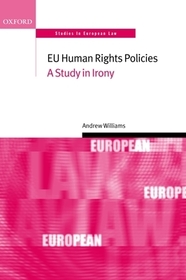
The EU's human rights policies are plagued by double standards: radically different approaches are applied in the EU's external and internal operations. In this book, Andrew Williams reveals the nature and scope of this bifurcation and the resultant discrimination, and argues that the irony revealed undermines both the EU's commitment to human rights and its moral credibility.
MoreLong description:
Despite recent constitutional arrangements, human rights remain an ambiguous and complex subject in the European Union. Human rights issues may have become increasingly relevant to the life of the EU over the past thirty years but there has been an institutional reluctance to mould a unified human rights policy worthy of the name. Nevertheless, the EU's practices have not been constructed randomly: they have evolved within discrete policy realms along coherent narrative lines. From the arguably mythical basis that the EU was founded upon a general principle of respect for human rights; policies and practices have developed along two distinct paths. Internally, within the EU, human rights are contingent. Scrutiny is erratic and even casual, and enforcement is left to the courts and independent agencies. Externally, in the EU's interactions with non-members, however, the story is very different: human rights are broad in concept. Collective notions of rights are accepted and promoted. Scrutiny can be intrusive and effective, and systems of enforcement, increasingly severe in scope and strength, have been applied.
This bifurcation has direct implications for the EU's constitutional structure and its future human rights activities. It suggests that, through human rights language, conditions for conflict rather than integration have arisen, and that a system of double standards has been instituted. Williams therefore argues that the EU's claims to a credible human rights policy are suspect.
This book examines the nature and scope of the bifurcation and explains its origins and development. In doing so it questions orthodox interpretations and provides a radical new reading of the EU's human rights law and practice. At its heart, the book claims that without a fundamental reappraisal of the basis upon which the EU responds to human rights, it will remain plagued by this ironical condition.
Table of Contents:
Preface
Acknowledgements
Introduction
Development Policy and Human Rights
Accession to the EU and Human Rights
The Scope of Internal-External Incoherence
Explaining Incoherence: the Orthodox Arguments
The Invention of Human Rights in the EU
European Identity and Human Rights
Conclusion

